
Logan and Albert Conservation Association

 Logan / Albert / Southern Moreton Bay: Two fails in a row:
three strikes and you’re out?
The
The Logan / Albert Rivers and Southern Bay situation are worth so much to the State and the nation in a healthy condition that preventing an ecological shut down of the system must now be seen by the State Government as a ‘matter of State interest’.
Current international trends, highlighted by the recent Conference of the Parties to the Convention on Biological Diversity (COP-10) that concluded on October 29 in Nagoya, Japan, place increased imperatives on nations to adopt measures which incorporate the economic value of ecosystem services.
Queensland's ‘wild rivers’ legislation, which effectively frames the rivers as ‘biodiversity infrastructure’ whose systems, just like those of a road for example, must be made functional for the whole to begin to work is an exemplary model. It is possible that PES (payment for ecosystem services) could be applied to legislation to protect riparian areas, giving landholders cost neutral outcomes for productivity losses, fencing, revegetation etc.
We need to complement (or replace as necessary) the existing strategies with new whole-of-system initiatives over the next decade.
Read some coverage here in local news where several conservation group executive members express our concern.
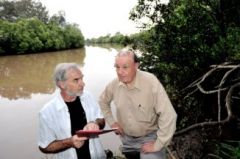
"We are presiding over the final stages [of death] of a once healthy, productive and magnificent river system" said Barry Fitzpatrick. Unless we ensure that our river systems and bay are returned to a healthy functioning ecosystem, future health and wellbeing of the region is in jeapardy.
 Fascinating and free reptile workshop
Capture your creatures on film after you find them - or they find you!
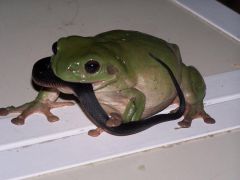
Brian 'Furry' McLean of Crocodiles and Dragons legend will demonstrate lots of useful information about our local reptile residents so that we can all live together harmoniously.
John McCann – professional wildlife photographer from Nature Pics will provide some secret so we can capture your creatures on film - the only way to catch them.
SATURDAY 6 NOVEMBER 2010
2 – 4.30 pm
CWA Hall Brisbane Street Beaudesert
LACA kindly thanks Scenic Rim Regional Council for funding the workshops through its Community Environmental Assistance Grants Program.
Our local zoologist - ecologist came to our assiatance at the last moment due to unforeseen circumstances. Thank you Ronda Green. Many cameras wer clicking madle as all attendees at our success workshop got very up close camera moments with Furry's creatures which are very used to the public - unlike our shy native animals in their natural habitat.
We hope to post some images soon so stay tuned. The shin of the crocodile is incredibly soft.
Local newspaper Jimboomba Times is now available online and have reported on this environmental isue here.
Senior member of the Healthy Waterways scientific expert panel Professor Rod Connolly presented the results to the southern region audience at the Gold Coast.
"With Logan we saw a slight improvement which came from a slight reduction in the levels of sediment and nutrients in the river," he said.
"The message for Logan is that what council and landowners are doing is excellent but we need to be working harder on two things.
"The first is the need for better processes in the development of greenfield sites, if we want healthy waterways we need to prevent sediment from escaping into our rivers.
"The second thing refers to rural areas where we are seeing a change from pastoral activity to all sorts of other land uses and again we need to ensure the sediment created by this change does not make it into the river.
"Planting bankside vegetation is one way of doing this but it is important for both council and landowners to take responsibility.
"Council's recent investment in sewerage treatment plant upgrades has been one of the most significant factors in improving the health of its waterways and hopefully it will result in further improvements."
Professor Connolly said he had considered the Albert Catchment to be in reasonably good condition but that the drop from an A- to a B- was a surprise.
"This is a meaningful decrease but at this point I couldn't jump in and say what the causes are," he said.
"We need to do more detective work to find out what has gone wrong before we can go down that route.
"Overall I would like to see more investment in waterways and we need to look at the new bulk water authorities to contribute a large fraction of the pie.
"More support for landowners and catchment groups would also be welcome."
Asked what impact new urban cities at Yarrabilba and Flagstone might have, Professor Connolly said as long as Water Sensitive Urban Design (WSUD) principals were followed, there was no need for a negative impact on waterways.
"The history of south-east-Queensland shows that when you have substantial number of people moving to new developments there is a decrease in the health of the streams and estuaries," he said.
"There are things that can be one to prevent this however and it just depends on how much the community wants to dedicate to the health of our waterways."
Senior member of the Healthy Waterways scientific expert panel Professor Rod Connolly presented the results to the southern region audience at the Gold Coast.
“With Logan we saw a slight improvement which came from a slight reduction in the levels of sediment and nutrients in the river,” he said.
“The message for Logan is that what council and landowners are doing is excellent but we need to be working harder on two things.
“The first is the need for better processes in the development of greenfield sites, if we want healthy waterways we need to prevent sediment from escaping into our rivers.
“The second thing refers to rural areas where we are seeing a change from pastoral activity to all sorts of other land uses and again we need to ensure the sediment created by this change does not make it into the river.
“Planting bankside vegetation is one way of doing this but it is important for both council and landowners to take responsibility.
“Council’s recent investment in sewerage treatment plant upgrades has been one of the most significant factors in improving the health of its waterways and hopefully it will result in further improvements.”
Professor Connolly said he had considered the Albert Catchment to be in reasonably good condition but that the drop from an A- to a B- was a surprise.
“This is a meaningful decrease but at this point I couldn’t jump in and say what the causes are,” he said.
“We need to do more detective work to find out what has gone wrong before we can go down that route.
“Overall I would like to see more investment in waterways and we need to look at the new bulk water authorities to contribute a large fraction of the pie.
“More support for landowners and catchment groups would also be welcome.”
Asked what impact new urban cities at Yarrabilba and Flagstone might have, Professor Connolly said as long as Water Sensitive Urban Design (WSUD) principals were followed, there was no need for a negative impact on waterways.
“The history of south-east-Queensland shows that when you have substantial number of people moving to new developments there is a decrease in the health of the streams and estuaries,” he said.
“There are things that can be one to prevent this however and it just depends on how much the community wants to dedicate to the health of our waterways.”
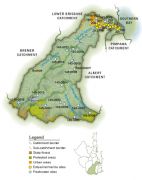 SEQ environment groups warn of the looming threat to Moreton Bay from the sheer scale of proposed urban development throughout the region. Over a decades worth of achievements could be undone if the massive new unsustainable urban development throughout SEQ is allowed to occur with out having to fully consider and put in place measures to avoid impacts to waterways.
Large-scale catchment wide rehabilitation projects and the adoption of world's best development standards in the vicinity of one billion dollars needs to be invested to repair catchment degradation throughout the region; otherwise the ecological health of Moreton Bay is likely to continue to decline overtime.
Another F for fail for the Logan River Estuary surely should mean that all levels of government should be aware of the damage our present human activites is causing and business as usual - despite the rhetoric - will not reverse the degradation.The southern Moreton Bay Ramsar site is also in poor health.
'The 2010 report card shows the condition of the Albert and Logan estuaries remain in poor condition, despite over ten years of hard work to improve their ecological health. The poor estuary health is caused by high nutrient and sediment levels, which is continued to be caused by existing inappropriate urban and industrial development throughout the catchment. Impacts to waterways are set to escalate if a business as usual approach is taken to the massive urban development planned for our part of the region.
When will the political will change to work towards a healthy catchment and ecosystem whose value for longterm human survival is essential. Without a healthy ecosystem [planet] we will not have a healthy sustainable lifestyle.
Queensland Conservation Association released their comment in this media release. QCC_healthywaterwaysreportcard20oct.doc Bytes 01/01/1970, 10:00
23 October 2010 - great day for conservation
Save Bahrs Scrub Alliance launch of booklet Endangered, Vulnerable and Near Threatened Flora of Bahrs Scrub
Saturday, October 23, 2010 Beenleigh Bowls Club Hanover St Beenleigh
11:00am – 12:00pm
 Download your invitation here.
  INVITATION_SBSA_FLORA_BOOKLET_LAUNCH.pdf
More information is available at http://www.bahrsscrub.org.au/
Veto fundraiser supper dance 7-11 pm
49-65 Kenny Rd Chambers Flat / Logan Village Community Hall
Tickets phone Lil 38035541 or Mary 38033320 or at the door ($10 single family $30)
See what is happening at www.veto.org.au
SURVEYS or CENSUS COUNTS for two local bird species - Sunday 31 October 2010
Glossy Black Cockatoo and Australian White Ibis.
If you want to take part in the Glossy Black-Cockatoo Birding Day check on the Conservancy website here.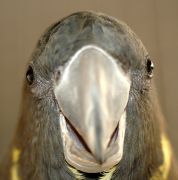 Source: Guy Castley
As the Glossy Black Cockatoo may be confused by another black bird, identification workshops are being held for those interested in helping. The Conservancy website has great identification tools as well. Please register at site linked above if you can help.
The Australian White Ibis is a protected native species that plays an important role in their natural wetland habitat. However, drought and inland water management issues have contributed to the White Ibis shifting to urban areas where they have found plentiful food, particularly at waste landfills. As a result, urban White Ibis populations have exploded over the last two decades. They are now often perceived as a 'pest' because of their nuisance value, risk to aviation safety, and impact on biodiversity.
Your participation in this survey will aid the long term conservation and effective management of Australian White Ibis by providing a better understanding of their distribution and abundance throughout Australia. Download a flyer here.Salisbury to Beaudesert Rail Corridor Study
The Department of Transport and Main Roads has commenced the Salisbury to Beaudesert Rail Corridor Study and public consultation is now underway. According to Queensland Transport, public consultation is an important part of this study and they want our feedback on the Review of Environmental Factors. This report is based on a desktop investigation, and includes information on the proposed rail alignment and station locations, and how the alignment has been identified. The executive summary states that
It is anticipated that development of the passenger rail line would likely be implemented instages and only commence after 2026 subject to the realisation of projected passenger demand in future growth areas and funding decisions of the Queensland Government. Prior to delivery of a passenger rail line, interim public transport solutions would beimplemented to service emerging communities in the study area.
You are invited to provide your feedback up to 29 October 2010
This tmr website provides links to newsletters,timelines, maps, Review of environmental factors (REF) report, and a feedback form. The study team held various community information displays. To be kept up to date and receive updates as they become available contact the Corridor Study team by Email: This email address is being protected from spambots. You need JavaScript enabled to view it.
You can support the Queensland government's new vision to make 80 per cent of North Stradbroke Island (NSI) national park  Drawing by Jennie Truman
by sending a short simple email.
We must let the State government know urgently there is wide support for a national park on North Stradbroke Island and for ending mining. If you have already sent in a submission, we're asking you to send another and to ask your colleagues, friends and family to write as well. Maybe even print out letters and ask people to sign them?
According to the Queensland Government's website http://www.derm.qld.gov.au/stradbroke/index.html Queensland Government is committed to North Stradbroke Island becoming a vibrant sustainable community of traditional owners, residents and visitors; capitalising and safeguarding the natural landscape values of the island. By the end of 2011 more than half of the island will be national park.
Such a vision would provide a future economic base for the North Stradbroke Island community and deliver on the government's commitment to sustainable growth and development.
EVERY SUBMISSION COUNTS AND CAN SIMPLY SAY
I want to register my support for the Queensland government's new vision to make 80 per cent of North Stradbroke Island (NSI) national park.
* The island will be a great national park, so close to Brisbane.
* Protect all its rich diversity of flora and fauna, including koalas.
* Gazette as much national park as possible this term ofgovernment (more than 56 per cent).
* Make remaining untouched or lightly disturbed land national park before it's mined, not after.
* End mining as soon as possible: it's had 60 years, and Stradbroke cannot withstand any more destruction.
* Start the island's economic transition now to low-impact, nature-based tourism.
* Ensure mine workers and their families are given due consideration as the mines close.
* Implement joint management of the national park with the island's traditional owners.
Include your name and contact details - and remember: interstate and overseas submissions are valid.
Send to: This email address is being protected from spambots. You need JavaScript enabled to view it.
cc This email address is being protected from spambots. You need JavaScript enabled to view it.
Visit theStradbroke Island Management Organisation website to read about the great work that community group is doing.
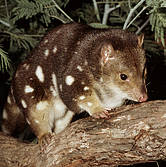 Logan and Albert Conservation Association aka LACA president, Anne Page, is spending her holidays visiting residents in the areas Murnuben Greenbank North Maclean. She is doing this to collect the much needed data about wildlife or fauna presently living in these treed or vegetated areas.
She will leave a letter if residents are not at home when she visits. Why you may ask does one volunteer to talk to walk around these areas in the hope of gathering local residents' sightings of native animals seen on properties in these areas?
Anne intends to start on the southern side of Stoney Camp Rd and do the perimeter properties around the large farm at Greenbank east of Teviot Rd first. Then she will go North Maclean area and work through properties adjacent to Wearings Reserve in Munruben . Each interview will probably take a minimum of 30 mins (as per experience) . She hopes to do as many as she has time for in the next 2 weeks and then keep going after the school holidays.
Energex Logan River to Jimboomba Protest Rally at Parliament - Thursday 7 October 2010
 Please consider supporting the action described here and organized by Paul Casbolt on behalf of VETO (Veto Energex Towers Organisation) that is protesting against the upgrade and new easement for a 110 Kv line to cross the Logan River 5 times and run south along Camp Cable Rd.
This proposed route will clear 42.5 hectares of koala habitat which also provides valuable habitat for other threatened species in the area eg quolls, green thighed frog, wallum froglet , glossy black cockatoos and 4 species of gliders (greater, squirrel, sugar, feathertail) that we know about from community surveys.
LACA has been assisting VETO for the past 2 years and has provided formal submissions to all rounds of community consultation (please see the LACA or VETO websites for copies of LACA and VETO submissions outlining major concerns). President Anne Page has attended fortnightly meetings over this time along with many other concerned members from the Logan River and Camp Cable Rd communities.
There are many reasons why the community should be objecting to such projects (see LACA submission ) in our local area and across Queensland. If you are able to attend this peaceful rally please RSVP to Paul ph 3200 5210 (see flyer contacts). There will be a coach bus to pick people up from Logan Village Community Centre at 10 am and will return there around 1.30 pm (cost $8 per person please to cover bus hire) .
The Hon. Margaret Keech has already agreed to meet the group and take receipt of the petition outside Parliament House.
This joint Rally with other Community Groups (also dissatisfied with the Energex process) may be our best chance to influence State Politicians as it is likely that Minister Stephen Robertson will make a decision on the Loganlea to Jimboomba 110kV Sub Transmission Line Community Infrastructure Designation in December.We hope to get wider media interest and support by joining with the Sunshine Coast group and the STOP group from the Gold Coast.
This will be a civil, peaceful protest and children are welcome as this is for their future (unfortunately Parliament does not sit during school holidays).