
Logan and Albert Conservation Association

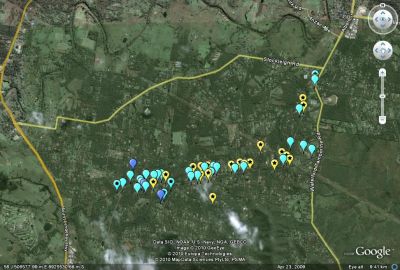 This image of glider sightings has been compiled from sightings reported from residents along Camp Cable Waterford Tamborine Road and Hotz Road as part of the VETO survey from March to June 2010.
The blue marker represents feather tail glider sightings. The aqua marker represents sugar glider, squirrel glider or general glider sightings.
The aqua marker with the star represent the greater glider sightings. The yellow markers represent residents who reported wildlife sightings but did not report glider sightings. There was a total of 50 residents (mostly directly affected and some indirectly affected) so far who have reported these results to VETO.
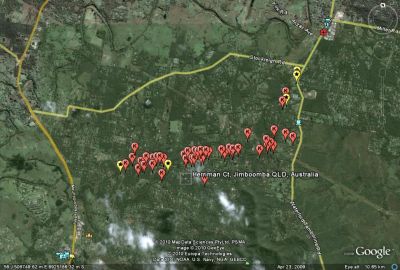
This image with the VETO willdlife sightings from the surveys conducted from March to June 2010. Some are current sightings and some are historic sightings. There are a total of 50 residents surveyed so far (mostly directly affected and some non directly affected) . The red markers represent koala sightings reported by residents . The yellow markers represent residents who did not report seeing or hearing koalas on their property.
The use of digital tools available for us all now - as and when we learn how to use these webtools - are an essential piece of out activist - advocacy toolkit. Photos maps aerial images from Google Earth or NearMap can help us support our efforts to secure ecologically sustainable development.
Business as usual is not acceptable for us now, our children and future children.
YOUR SUMBISSION IS IMPORTANT FOR THE SUCCESS OF OUR CAMPAIGN. YOUR SUBMISSION CAN MAKE A DIFFERENCE.
Loss of essential habitat for koalas, gliders glossy black cockatoos and other wildlife.
Loss of scenic amenity and destruction of ambience of natural bushland.
Continuing investment of our money in old technology ie high poles and coal fired electricity.
Loss of opportunity to invest in renewable energies and more.
Logan River health is further impacted.
SAVE OUR KOALAS!
NO TOXIC DUMP IN IPSWICH!
 Public Meeting 3 July 2pm - 4pm Rising Sun Hotel, 27 School Rd, Rosewood
Dr Patricia Petersen has organised a public meeting for local residents concerned about a large-scale, hard-to-place, high impact industries site proposed for Ebenezer, a rural area south-west of Ipswich. High impact industries involve noxious, offensive or hazardous operations. This can include chemical storage, irradiation plants and the processing of banned organochlorine pesticides such as DDT, dieldrin and PCBs. It is totally unacceptable that an industrial development such as this should be considered for this area. Farmers and other residents in Ebenezer rely on clean rain water for drinking and household use, soil and crop production. Beef and agricultural industries out this way are currently very strong, they are thriving.
If this development goes ahead, it will be catastrophic. It will negatively impact on livelihoods. Because the area doesn't have impervious clay, local aquifers will end up being contaminated These feed into the Mr Walker Creek, which flows into the Bremer and Brisbane Rivers. Ipswich doesn't need an environmental disaster such as this, neither does South-East Queensland. The Bremer River is still recovering from a chemical 'dump' from Amberley RAAF Base a year ago, which polluted the waterways.
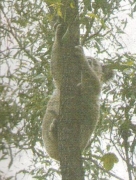
There is grave concern about the impact that this proposed industrial estate will have on koalas. This area has the highest density of koalas in South-East Queensland. The koalas are healthy, have a long lifespan and are Chlamydia free. If they are disturbed, this koala habitat will be lost forever. This is supported by the Ipswich Koala Protection Society.
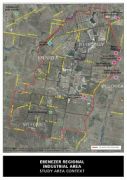 NOT IN ANYONE'S BACKYARD and ESPECIALLY NOT having one of our rivers as the boundary.
LACA has for a long time viewed the Bromelton site as one of regional significance with an additional threat to Moreton Bay although no one else seems to be noticing. The area around the landfill and strong smelling industries is one of concern - with more details being available from our campaign website www.lovetheloganvalley.org.au managed by Brooke Hynch.
The Love the Logan Valley Campaign has been formed out of a group of individuals who love the clean living values that the Logan Valley represents, with its clean air, its clean water, clean food and clean living. If the Valley is to have a large industrial city in it then these industries should reflect our clean environment and not be dedicated to toxic, noxoius and hard to place industries.
Our members include people from all walks of life - farrmers, eco-tourism operators, environmental scientists, mums and dads who live in the area and want to make sure the health and well-being of their children, and their children's children are secured for this valley.
The Ebenezer site is a new proposal that has comes out of the blue - this one drains into Warril Creek, then the Bremer and then the Brisbane River. A major incident at either would contaminate either waterway. It and another area Wellcamp near Toowoomba are discussed on the Department of Infrastructure and Plannin website. See the links documents and maps from this page.
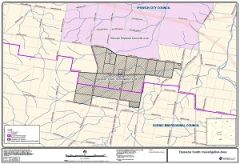 According to that page the government is identifying new industrial land for large footprint, difficult-to-locate and high impact industries in a sustainable way by:not locating industrial zones in environmentally sensitive areas considering infrastructure requirements separating incompatible land uses considering the commercial needs of these types of industries.
They recognise not all large footprint, difficult to locate and high impact industries have the same requirements. For example, some require good access to road, rail and port infrastructure, some need large amounts of water and electricity, some require good separation from sensitive land uses and others need to be located close to resources and/or their markets. These considerations also form part of the study.
The community has been fed limited information on Bromelton for over five years with secret reports funded by developers
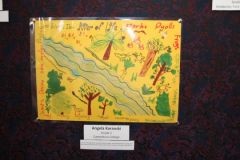 Seven year old Angela Koranski is in Mrs Olsen's year 2 class at Canterbury College. Angela recently entered the Logan City Council's World Environment Day Poster competition. Angela was selected as one of thirteen winners. Her winning entry will be displayed at the Logan Art Gallery and her poster will be reproduced as part of a Logan City Council calendar.
"I live on the Logan River. So do lots of birds, reptiles, mammals and plants. Cutting down trees means the animals won't have a home. Nature is special. We need to look after it!"
 UNEP launches a new report that states restoring lost and damaged ecosystems—from forests and freshwaters to mangroves and wetlands—can trigger multi-million dollar returns, generate jobs and combat poverty. The report, entitled Dead Planet, Living Planet: Biodiversity and Ecosystem Restoration for Sustainable Development, underlines that far from being a tax on growth and development, many environmental investments in degraded, nature-based assets can generate substantial and multiple returns.
The TUNZA Regional Youth Conference on Biodiversity continued today in Kigali, Rwanda. The conference began on 2 June and will see 35 youth from around all sub-regions of Africa share and discuss biodiversity in Africa.
Achim Steiner, UNEP Executive Director says
"Let WED 2010 be a moment-- of many moments in 2010-- when the history books record that the world took note,
seized the opportunities and deployed its collective knowledge,
abundant science and technology, financial acumen and prowess, intelligence and compassion to
build a global society with value-environmental, social and economic."
 Biodiversity is the variety of all living things; the different plants, animals and micro organisms, the genetic information they contain and the ecosystems they form. Biodiversity is usually explored at three levels – genetic diversity, species diversity and ecosystem diversity. These three levels work together to create the complexity of life on Earth.group is linked to the International Year of Biodiversity 2010 website, a joint venture between the Australian Museum and the Council of Australasian Museum Directors (CAMD). This project includes museums across Australia working with people and communities to discover, celebrate and promote biodiversity, and encourage participation in biodiversity events all around the country.
Flickr.com is an amazing social website which allows us to share globally - or privateIy our photos videos and more.
The International Year of Biodiversity 2010 Flickr website is intended to be a 'biodiversity hub' for events in Australia. The site allows you to promote your biodiversity news and events, share your stories and ideas.
The aim of this group is to invite you to post your photos here and have them displayed also on our International Year of Biodiversity 2010 website. You can also add stories, follow our Twitter feed and even share videos - anything to do with biodiversity is warmly welcomed!
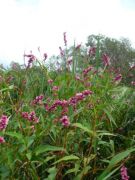 Cornubia wetlands is being cared for by a local Logan bushcare group under the leadership of LACA member Barry Fitzpatrick. He has developed a website.
That community group are playing an integral role in helping to maintain a healthy benthic plankton in wetlands - by not creating sediment, runoff of garden fertilisers etc
To follow the progress of the protection of this unique wetland area explore the site and images here.
The health of wetland areas contributes to the health of our river systems. Cornubia is a very heathy ecosytem with Nature's natural processes being in balance.
Our Logan River does not have a healthy report card having failed the 2009 Healthy Waterways reporting process. This is a situation where all levels of government should be concerned - and being pro-active. The huge burden of population growth will futher degrade the river - unless better processes are mandated and funded.
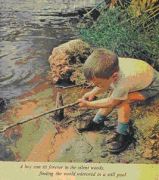 From all sections of the globe the scientific community is alerting us to the risks that our children and future generations will face if our new urban designs fail to account for the full potential for humans to develop in their natural evolutionary home. In America an organization Children and Nature has been working for several years to help us understand - and to provide assistance - the essential connection humans have with natural areas. This is the bush, fresh water country creeks, boulders and hills, forest litter, butterflies and bugs, all species great and small. Children need freedom to explore in their own time, in their own - to play in the dirt.
There are many resources available on their website. http://www.childrenandnature.org
The built environment does not provide the same opportunities the physical, mental, and social benefits that contact with the outdoors and nature provides to children.
Now that globally more than 50% of people live in cities, unless natural areas are included within accessable walking range, we potentially run the risk of losing the breadth of all of human stages of development.
In Australia research concurs with a 2007 State Government investigation into playground spaces in Victoria finding that young children ''need exposure'' to natural environments to appreciate the ''complex variations of texture, sound, light, smell, colour and temperature''.
The subsequent government report - The Good Play Space Guide - highlighted the creative impulses that can be fostered by play with the ''loose parts'' of nature - the leaves, twigs and gumnuts. But how realistic is it to expect today's kids to get out in the bush?
 If you are reading this you are probably concerned about the impact that our human lifestyle is having on our home planet earth. Humans often display strange behaviours - many of which we seldom stop to think about. We usually do what we've always done - until something happens to make us see things from a different viewpoint.
Are you and your household careful and considerate of the ways you do things? Are you frugal - as our grandparents were - or do you do or buy something because you can? And not bother about the cost - money or cost to the environment?
Help us find out why we do things.
Anna Cooke is undertaking a PhD about people's motivation for household environmental behaviour.
Can you help her gather data to analyse? More data will give greater value to her research. It is totally anonymous!
It will take about 15 minutes. You will be asked about your daily energy use - information is given on your electricity account.
She's hoping to reach a wide range of Australians. Please circulate widely.
Contact Anna for more info or just cut and paste the following into your web browser. If you do not have internet at home, go to your local library!