
Logan and Albert Conservation Association

 Natural Resources, Mines and Energy Minister Stephen Robertson has launched a volunteer program aimed at harnessing people power for environmental projects across the state.
Green Nomads is a new casual environmental volunteering placement program targeting the resources and skills of Australia's largest transient population, grey nomads. Mr Robertson said the initiative would have many benefits with volunteers working to care for the environment, while also building ties with follow workers and the communities they assist. This is an avenue for people who may have some spare time on their hands to assist in the protection and conservation of our unique natural resources.
"We are so lucky to live in such a wonderful state which has rich natural resources and this is a very practical way people can help ensure theses resources are maintained and protected," said Minister Stephen Robertson at the recent launch.
Championed by Queensland Water & Land Carers (QWaLC), a new website will link interested volunteers with environmental projects in the area they live or the areas where they are planning to travel. Possible environmental projects ranged from tree planting to gathering seeds of local native species. The Queensland Government is providing QWaLC with $300,000 for administration and insurance for this registered volunteer group.
"It is only through awareness that people can begin to take action to protect and care for the environment and this program allows people to develop that perspective while helping natural resources management groups with the challenges they face," Mr Robertson said.
The program website is www.greennomads.com.au
Registration is required for volunteers and information is available from the website for Community NRM Groups who would like to host Green Nomads. New groups applying for incorporation can also benefit from this program.
 AYCC Australian Youth Climate Coalition have emailed the video linked here from youtube to every federal politician's office to remind them that a youth climate movement is building. One minute and forty seconds of pure awesome-ness. Check it out below. Help make this video for AYCC and Power Shift a hit.
The AYCC is a growing coalition of 27 member and partner youth organisations from across Australia whose mission is to build a generation-wide movement to solve climate change, through uniting diverse youth organisations around this common challenge.
Through member groups, they aim to inspire, educate, empower and mobilise young Australians to take action on climate change - coordinating, communicating and networking with each other, and running shared projects and campaigns. Website:http://www.aycc.org.au . A list of member groups and partners is available here. School groups can also become members, please contact Ben at ben.margetts [a] youthclimatecoalition.org
 National Climate Emergency Rally 13 June 2009 - join across Australia on 13 June 2009 in a peaceful rally for urgent action and leadership to avoid catastrophic climate change. On Monday 5 May 2009, Prime Minister Kevin Rudd reneged on his 2007 election promise to take action to avoid catastrophic climate change. The clear majority of national and state conservation groups have jointly written to the Prime Minister, voicing their incredulity at this about-face. LACA joins these groups in condemning the Federal government's dilution of its Carbon Pollution Reduction Scheme (CPRS). Open and read the joint letter from the conservation sector to the Prime Minister.
  Joint_Statement_from_Conservation_Sector_to_Prime_Minister_5_May_2009.pdf 557.07 Kb 05/06/2009, 20:01
Join the rally on 13 June at 1pm Queens Park, corner of George and Elizabeth streets, Brisbane CBD.
More information go to http://www.climaterally.org/
WEAR RED to signify a climate emergency and bring banners and signs.
The draft Border Ranges Rainforest Biodiversity Management Plan has recently been released for public comment. This is your opportunity to get involved in guiding the direction of recovery actions for the rainforests and related communities, and their component species, found in the Border Ranges Biodiversity Hotpot area over the next 10 years. The public comment period closes on Friday, 28 August 2009.
The draft recovery plan, its appendices and maps can be downloaded from the Department of Environment, Heritage and the Arts' website, visit http://www.environment.gov.au/biodiversity/threatened/publications/recovery/border-ranges.html. For a hard copy, contact the Department's Community Information Unit, email: This email address is being protected from spambots. You need JavaScript enabled to view it. or Freecall: 1800 803 772.
The extract below is from the Department's website:
"The Border Ranges Rainforest Biodiversity Management Plan constitutes the formal national regional recovery plan for threatened species and communities of the Border Ranges North and South (Queensland and New South Wales) Biodiversity Hotspot. The Plan considers the conservation requirements of rainforest and closely related species and communities in the Border Ranges region of NSW and Queensland, which is centred on the McPherson Ranges. It also addresses other species of conservation significance so as to manage the area's biodiversity in a holistic and cost-effective manner.
The Plan identifies the actions to be taken to ensure the long-term viability of the threatened and significant species of the rainforest and related vegetation of the Border Ranges Hotspot, including those that:
Comments on the draft recovery plan should be sent to:
Mail:
Director
Recovery, Planning and Implementation Section
Department of the Environment, Water, Heritage and the Arts
GPO Box 787
Canberra ACT 2601
Email: This email address is being protected from spambots. You need JavaScript enabled to view it.
Fax: 02 6274 1921
 The article by Brian Williams in the Courier Mail for 29 May 2009 is sobering reading. It also provides an opportunity for any concerned resident to comment with information of their own experiences.
Click on the following text to make your observations or comment. Have your say: Have you noticed a decline in koala numbers?
Call to list koalas as vulnerable relates the plight of the iconic koala whose habitat has been eroded by clearing for development.
Read the article, submit your comment and please consider sending a letter to Sustainability Minister Kate Jones, Federal Environment Minister Peter Garrett and Queensland Premier Anna Bligh.
CONSERVATIONISTS have applied for southeast Queensland koalas to be listed as vulnerable.
If listed under federal laws, the Environment Protection and Biodiversity Conservation Act will kick in, forcing anyone clearing land in koala habitat to ensure it does not affect the animal's prospects for survival. The report just released by Sustainability Minister Kate Jones last week confirmed that koala numbers had declined by 64 per cent in the past decade.
 CURRENT EPETITION
Queensland residents draws to the attention of the House the community's total opposition to the construction of this power line because it will be a permanent obtrusive and dangerous structure that will cause:
- damage to this unique environment by destroying vegetation, native animal habitat and resulting in erosion of the riverbank, the loss of community amenity and visual amenity (restricting current and future uses of the river by visitors and residents and spoiling this beautiful green landscape and valuable community asset);
- potential health and safety risks to residents, maintenance and emergency workers during floods and to grazing and native animals; and
- adverse impacts on property values.
The House should note that the construction of this power line totally contradicts the principles of the Queensland Government's Towards Q2 plan (Green Qld - Protecting our Lifestyle and Environment) which stresses the need to 'protect our natural landscapes' and to 'retain the green spaces between neighbourhoods and regions that create a natural break in our built environment and protect areas that support our unique native wildlife and fragile ecosystems'.
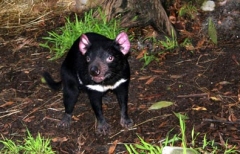 International environmental news sources report that Australia's Tasmanian Devil, its population decimated by a facial cancer, was listed as an endangered species on Wednesday by the Tasmanian state government 21 May 2009. msncb.msn.com shows a picture taken on January 13, 2009 of a healthy Tasmanian devil joey (Sarcophilus harrisii) displayed as part of an intensive conservation programme, because of the spread of an infectious facial tumour which gradually disfigures the animal's face to the point it is unable to eat, at Taronga Zoo in Sydney.
Australia's Tasmanian devil is the world's largest surviving marsupial carnivore. This increased risk of extinction status change means that more resources and measures will / can be allocated for greater protection and recovery strategies. Numbers have declined by 70 percent since cancer was first reported in '96.
The deadly and disfiguring facial cancer, which often kills within months, has cut the island state's wild devil population by as much as 60 percent. The Tasmanian Devil faces extinction in 10 to 20 years due to the facial cancer.
"We are committed to finding an answer and saving the Tasmanian Devil for Tasmanians and the world," Tasmanian Primary Industries Minister David Llewellyn said in a statement announcing the change in status from vulnerable to endangered.
The Tasmanian Devil is a carnivorous marsupial about the size of a small muscular dog. It has black fur, gives off a skunk-like odour when stressed, and earns its devil name for its ferocious temperament and disturbing call. The facial cancer is genetically identical in every animal and originated from a single contagious cell line and spread throughout the population by biting during fights for food and mates.
"We are developing and implementing an insurance strategy which has established captive populations around the country, implementing wild management trials to attempt to secure wild populations," said Llewellyn.
Llewellyn said he was encouraged by the fact that some devils from western Tasmania had developed antibodies to facial tumor.
"While it is still very early days, discoveries such as this provide hope that the disease may be managed in the longer term and that devils with genetic diversity will survive it," he said.
The story with more links can be read here at msnbc.msn.com
 The latest report from the EPA and Courier Mail today on the 50% decline in Koala Coast koalas in the last 3 years is sobering news. The koala coast region includes the Redlands Council, east side of Logan Council and Brisbane City council. The koala population in the Koala Coast has been identified as genetically different to koalas in other parts of SE Qld which makes them even more important to protect for biodiversity values.
The Koala Coast area has had regions "protected" for the longest period of time as koala conservation areas and koala sustainability areas as part of the koala mapping that state government (EPA) has conducted in the past. The koalas of the "new Logan" Council area and Scenic Rim have not yet been mapped . Our koalas would certainly be in a worse position.
It is also important to note that the koala mapping conducted in Moreton Regional Council also confirmed that their Koala population had also declined. This news as reported on line in the Courier Mail is available here.
The Environment and Protection Agency EPA - Queensland government department - has published the findings and report from GHD on its www.epa.qld.gov.au page here.
The latest EPA report concerning the decline of the Koala Coast koalas has be provided for us.
You can access the document here. Decline_of_the_Koala_Coast_Koala_Population_Population_Status_in_2008.pdf 301.46 Kb 24/05/2009, 14:32
[Article in progress]
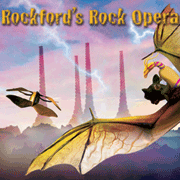 Rockford's Rock Opera is an original ecological musical story for children and adults which addresses the most serious environmental issues in a uniquely entertaining and yet thoughtful manner. And it's proving a huge hit around the world. Scripted by BBC comedian Steve Punt, and with music by Sweetapple, it tells the story of the Island of Infinity - home to all the world's extinct creatures.
Rockford's Rock Opera is an amazing adventure in sound for adults and children. Part One of the story (six chapters: 52 minutes) is free! It features narration, read along text, characters, sound effects and music and is available as a free mp3 download and an audio stream.
Great to listen to on your computer, your ipod or burnt onto CD, this is a free audiobook like no other. The website also contains useful background information about the story (including key information and free downloadable teaching resources about extinction and ecology), how the story was made and the facts behind the fiction.
Visit the website by clicking on link to the left to access free book and lots of other resources, perhaps even buy some products. WWF is supported by this group.

We all, the residents and citizens of Logan, have an opportunity to work together to learn to protect and enhance the natural environment. This does and will provide habitat and homes for the many native animals and also sustain the sub-tropical atmaosphere which we humans enjoy so much. Many creatures are being displaced and killed as a result of inappropriate clearing of vegetation.
A rapidly increasing human population is the driving force behind the eight proposed major development areas in Logan City. There has been no analysis of the carrying capacity of South East Queensland to place perhaps some constraints and conditions on developments.
The land has been, and is still, treated as a commodity from which we make money. The real cost has seldom been paid. With genuine ecologically sustainable development a balance can be achieved.
To take part in this forum you must belong to an incorporated group and be nominated as their representative. All members of such groups can raise concerns at group meetings and these may be included in the forum discussions.