
Logan and Albert Conservation Association

Logan media release published 19 July 2013
Keep Your Eyes Peeled For Koalas This October
Any sighting can be reported to Logan Council either on
3820 1103
or at logan.qld.gov.au/wildlifesightings
Logan residents are being encouraged to keep an eye out for koalas during an annual community koala survey.
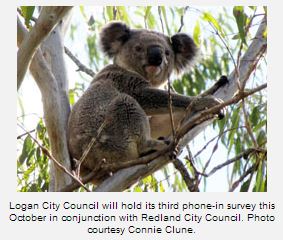 Over the weekend of 19-20 October residents will be asked to send in details of any koalas they come across in the bush, either in urban locations or rural areas.
Health, Environment and Sustainability Committee Chair Cr Trevina Schwarz said the weekend was about raising awareness of the region's most iconic residents and the importance of maintaining koala habitat corridors across the city.
"We know that koalas inhabit many areas within Logan City and it is essential that we continue to build our knowledge of their distribution and numbers," she said.
"During the sighting period, residents are asked to note down the locations and times of sightings and then report them to Council by phone or through Council's website.
"We urge residents to report as much information as they can – from size, location, health, behaviour, sex and species of tree; a photograph is also useful.
"While koalas do tend to spend most of their days asleep in trees or grazing, spring time is also mating season and they can be expected to be a little more active than usual – keep an ear our for their distinctive grunts at all hours of the day."
Cr Schwarz said the survey, now in its third year in Logan, was a good way to gather information on koala distribution not just in Logan but across the region.
"It's important that we make sure we regularly build a snapshot of koala distribution across the city to understand movement patterns and try to help manage urban growth across the city," she said.
"We are also partnering with Redland City Council, Moreton Bay Regional Council and the Koala Action Group to conduct surveys on the same day in an effort to build some regional information on koala movements between cities.
"This information is added to Council records and will assist with refining future whole of city koala population.
"Conservation isn't just for zoos, it's something we can all play a part in, even by just looking up during your morning bush walk or keeping an eye out when working on your property.
"I strongly encourage all residents to mark the weekend in their calendars and start to keep an eye out for koalas in their communities."
Any sighting/s can be reported to Council either on 38201103
or online at logan.qld.gov.au/wildlifesightings.
Koala hotspot in Logan is Berrinba Sanctuary at Browns Plains. See regular posting on their Facebook page
https://www.facebook.com/pages/Berrinba-Sanctuary/326254244157209?hc_location=timeline Click to see some of the latest photos.
The Coalition has made a pre-election commitment to 'fast track' pending international free trade deals by doing what the current Labor Government has stubbornly refused to do: accept dangerous legal provisions which will allow transnational corporations to sue Australia in off-shore tribunals - away from our own legal system - if our environmental and other public interest regulations get in the way of their profits.
If the Coalition is elected and pushes ahead with this commitment, we will almost certainly see the death of environmental campaigning as we know it in this country, along with significant weakening of environmental regulation.
The Trans Pacific Partnership Agreement (TPPA) is a huge free trade deal due to be signed off by Australia in October this year, and comes fully armed with corporate powers to sue participating nations in off-shore tribunals, known as Investor-State Dispute Settlement (ISDS) provisions.
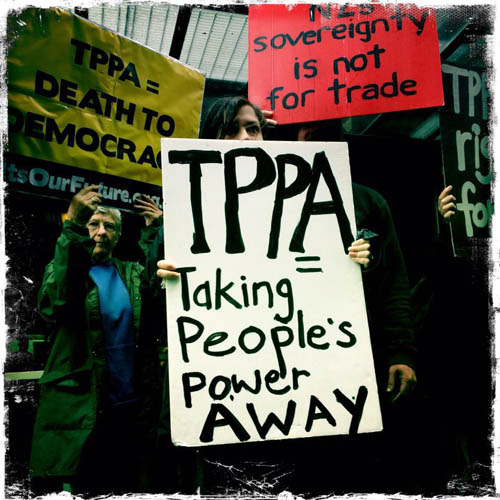 Under earlier free trade deals, including the North American Free Trade Agreement (NAFTA – the model for the TPPA), corporations like Chevron, Exxon Mobil, Dow Chemical, and Cargill had, by 2011, launched 450 investor-state cases in off-shore tribunals against 89 governments to fight environmental laws and regulations, including
challenges to bans on toxic chemicals, fracking, timber, mining regulations and programs
supporting green jobs and renewable energy.
Recent examples include the US Lone Star Mining company currently using ISDS provisions in NAFTA to sue the Canadian Quebec provincial government because it has suspended coal seam gas fracking pending a study of its environmental impact, and Peru, which has recently been required to pay Renco the largest ever damages award of USD$ 4.2 billion for banning products that had contaminated the city of La Oroya's environment and poisoned 95% of children there.
There are many, many more examples.
The threats posed by ISDS provisions in free trade agreements clearly impose a 'regulatory chill' effect on nations wanting to avoid the ongoing costs of defending their public interest regulations in off-shore tribunals away from their own jurisdictions.
Couldn't happen here?
There have been some 450 ENVIRONMENTAL DISPUTES arising out of previous free trade agreements which include ISDS provisions similar to those proposed for the TPPA:
By the end of 2011, corporations like Chevron, Exxon Mobil, Dow Chemical, and Cargill had launched 450 investor-state cases against 89 governments, including the US, to fightcommon-sense environmental laws and regulations. Among these cases were challenges to bans on toxic chemicals, fracking, timber,mining regulations, programs that incentivised green jobs and renewable energy programs.
Recently Peru has been required to pay Renco the largest ever damages award of USD$ 4.2 billion for banning products that had contaminated the La Oroya, Peru environment and had poisoned 95% of children there. An incredible outcome protecting the polluter!!
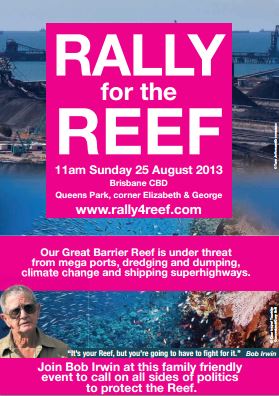 The Great Barrier Reef is facing the biggest, fastest and most widespread industrial development in its history.
The reef needs stronger protection now. Our politicians need to show leadership.With the Federal election looming, it's time to call on all sides of politics to unite to save the Great Barrier Reef.
Port expansions and developments must be stopped, and the Reef protected forever.
Do you want the Reef to become an industrial zone and shipping superhighway?
Join us at this family friendly event to call on all sides of politics to unite to protect the reef.
11am Sunday 25 August 2013
Brisbane CBD
Queens Park, corner Elizabeth & George
www.rally4reef.com
YOU CAN HELP SPREAD THE WORD.
Letterbox drop flyers around your local neighbourhood. Click on image to print rally flters and posters.
Ask if you can put up posters and leave flyers in surrounding cafes
Ask to put a poster up in your local library
Leave flyers at work
Ask friends and family to join you at the rally and help distribution around their local area

 What you can do:
Write short, concise sharp emails to the following:
Write today to the new Federal Minister for Trade, Richard Marles, urging him to continue the government's position of refusing to agree to the inclusion of the ISDS provisions in the TPPA. The Trade Minister's electorate contact details are at:
http://www.richardmarles.com.au/index.php?option=com_facileforms&Itemid=53
Write today to the Prime Minister, Kevin Rudd, urging him to protect Australia's sovereignty, farmland, water quality, environment, health care, and workplace rights by maintaining Labor's established position of refusing to agree to the inclusion of the ISDS provisions in the Trans Pacific Partnership Agreement negotiations. Mr Rudd can be contacted by email at http://www.pm.gov.au/contact-your-pm
Write to the Coalition Spokesperson for trade, Julie Bishop, asking the Coalition to adopt the same position as the Labor Government and refuse to agree to the inclusion of any ISDS provisions in the TPPA. Julie Bishop's contact details are at http://www.juliebishop.com.au/share-your-ideas.html
Write to the Leader of the Opposition and ask if you can get a 'blood oath' from him that the Coalition, if elected, will not agree to the ISDS provisions being included in the TPPA and any other free trade agreements in the future. Contact details are at http://www.tonyabbott.com.au/ContactTony.aspx
The Trans Pacific Partnership – a massive new free trade agreement where your vote may no longer count as a way of stopping unwanted CSG, coal mining, deep sea mining and other impacts by transnational corporations
 Who would want an Australia in which major transnational corporations can sue the Australian government in off-shore tribunals – away from our legal system and democratic process - for making laws which are aimed at protecting water quality, environment and farmland from inappropriate CSG and coal operations?
Who would want Australia to sign an international free trade agreement which could potentially wreck our Pharmaceutical Benefits Scheme, severely restrict our free use of the Internet and curtail our democratic rights?
Jane Kelsey, Professor of Law at Auckland University, has said: 'This locks the door on electoral democracy'.
It appears that, if elected to government, the Federal Coalition may be willing to go along with this.
The Trans Pacific Partnership Agreement (TPPA) is a massive free trade agreement currently under negotiation in high secrecy between Pacific Rim nations including Australia, Brunei, Chile, Singapore, Malaysia, New Zealand, Peru, the US, Vietnam, Canada and Mexico. Other nations, including Japan and possibly China, are set to join.
The TPPA includes provisions which, if agreed to by signatory nations, will give extraordinary powers to transnational corporations through Investor-State Dispute Settlement (ISDS) provisions. At the least level, these will put a 'chilling effect' on governments introducing new regulation around environment etc.
Fortunately the current Australian Government has steadfastly refused to agree to the inclusion in free trade agreements of ISDS provisions, in spite of great pressure from the US, transnational corporations and some sections of Australian industry.
However, the Federal Opposition has sent a clear message that, if elected, it will be willing to agree to investor state dispute settlement provisions in trade agreements in order to conclude a deal.
Proposed amendments to town planning regulations covering "Open Field Market Gardens" has been released for public consultation - closing 9 August 2013
Logan Council is suggesting amending parts of the old Beaudesert Shire Planning scheme of 2007.
http://www.logan.qld.gov.au/planning-and-building/planning/current-planning-schemes/beaudesert-planning-schemes/proposed-amendments is where you can read council's documents
The proposed amendments to the old Beaudesert Shire Council planning scheme would introduce code assessments for proposals over 8,000m2 (2 acres), that are currently exempt, and allow development in the Rural Living precinct in the Mt Lindsay Corridor Zone.
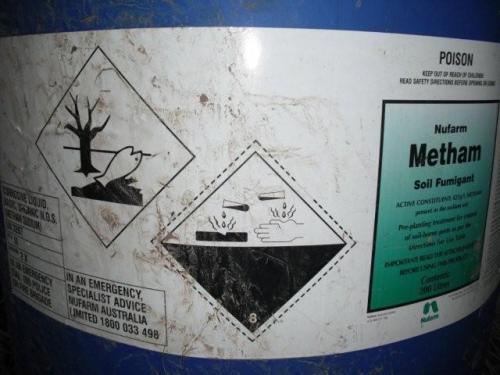 It is unfortunate that council continues to confuse the language used to describe the type of agriculture referred to in these documents. For the purpose of these planning documents the phrase 'intensive outdoor horticultural production' is referred to as 'open field market gardens'. This new term (which never appeared in the original BSPS2007) has been developed to refer to 'igloo type' intensive protected horticulture - but without the structures in which crops are grown.
In other parts of Australia there has been a long happy association of market gardens and supply of fresh local food - especially Sydney with its La Perouse farm. Three Heritage listed Chinese market gardens still exist started in 1800s.
Planning and Development Committee Deputy Chair Cr Jennie Breene (Division 12) said it was important residents and interested parties have a say to help inform community expectations and guide appropriate policy changes. Community strongly agrees on the importance of being genuinely involved in having a say in these matters.
"I understand there are strong views in the community regarding market gardens, so Council has decided to conduct open community consultation to help us understand community sentiment," she said. Strong views have been formed by residents who have been impacted by practices that have detrimental impact on their quality of living and also resulted in unexplained bird deaths.
"We understand that residents in rural residential areas choose to live in these locations for the rural amenity.
"However, we also understand that increasing demands for locally grown food mean land suitable for small-scale horticulture is increasingly being utilised as semi-commercial market gardens, regardless of zoning plan in place.
"By releasing these proposed amendments for public consultation we hope we can strike a balance between preserving rural lifestyle and helping create new local employment for rural residents.
"I would strongly urge all interested parties to make sure they have their voices heard by lodging a submission with Council before the closing date."
Copies of the proposed changes are available at all Logan City Council Customer Service Centres or at www.logan.qld.gov.au.
Submissions close on 9 August 2013 at 5:00pm.
Send your objections to:
Re: Amendment lC
Planning dePartment
Logan City Council
PO Box 3226
Logan City DC QLD 4ll4
Or email to : councThis email address is being protected from spambots. You need JavaScript enabled to view it..gov.au
Keep up to date with this issue by visiting The Greenbank Mozzie blog at this link. This local community blog has been established by local residents who are living in the midst of agricultural practices which mostly employ toxic chemicals. Although APVMA the Australian regulatory authority may have approved use of chemicals when used under cetain conditions by licenced people there is no easy way to alert authorities to concerns of misuse and use continues for many years after expoxure. One invesigation began 1995 and product is still available. Did you see recent Four Corners expose Chemical Time Bomb?
In the 1980s and 1990s governments across Australia outlawed the use of the herbicide 245T. The ban was introduced for one very good reason - 245T contains dioxin, a chemical impurity with the potential to seriously harm people who are exposed to it. But has the dioxin menace been tamed? Four Corners reveals evidence that this potentially deadly chemical compound may still be present in weed control products and that authorities do not routinely test for it.The program also reveals that this hands-off approach to regulation is entirely in keeping with the way governments have dealt with the lethal chemical dioxin over four decades. See program here.
http://www.abc.net.au/4corners/stories/2013/07/22/3806111.htm
Our rural residential lifestyle has been choesen by many of us for the provisioning of clean air clean water and clean food with a quiet ambiance of nature's sounds.
Koalas face carnage as loggers harvest timber plantations
Although the logging industry has claimed contractors were not deliberately hurting koalas, it is understood in some circumstances koalas are being knocked from trees, squashed and caught up in mechanical shredding machinery.
Where are the koala / wildlife spotters to check that each and every tree that is to harvested does not have a rsident koala? Are there no protocols to ensure safety of all wildlife?
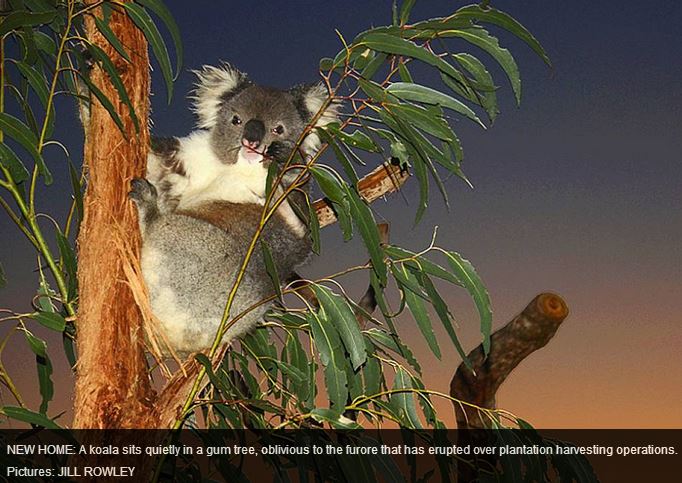 It is understood when the sprawling bluegum estates were planted around 15 to 20 years ago, there was little knowledge the hardwood plantations would become a significant refuge and a new food source for koalas.
However when you have a plantation of known koala habitat trees then surely it must signal strong possibility that koalas would move in to enjoy young green leaves? Koalas do not eat all gums. In fact of over 700 species of eucalypts koalas eat less than 20 species of gums!
According to a national academic, the issue is also now becoming a global issue given koalas are an "international icon". Koala expert Dr Stephen Phillips, who is a member of the Federal Government's Koala Abundance Working Group, said the emerging situation was "unfortunate" given the plantation estates were the way of the future and important economically for regional communities.
"They have a right to harvest, I certainly wouldn't like to see that change, that would be ridiculous," Dr Phillips said.
As with all of our industry rights, they must adapt to changing conditions. All timber plantations must be grown and harvested sustainably - that means not only in the fastest manner for greatest profit but with regard for all uses and users of the forest.
We thank the whistleblowers for alerting us to the blatent disregard the industry has shown for our native wildlife and exposing the horrendous animal cruelty to the iconic koala and other wildlife in the plantations. Australian Broadcasting Corporation, ABC ,Broadcast: 22/07/2013 with Reporter: Greg Hoy contains some graphic images and sounds of distressed koala. Watch here http://www.abc.net.au/7.30/content/2013/s3808542.htm. Transcript is also available of the interview.
Across the centre and south-west of Victoria and in South Australia, we, ABC, visited many volunteer animal refuges struggling without help from industry or government to cope with casualties.
TRACEY WILSON: Broken limbs, impact wounds, broken backs, severed arm. Dead mothers with joeys that are still alive, trying to survive. I had one 500 gram joey, about this big (demonstrates size with hands) that had two healed broken arms. And so we can only assume from that that the mother had been dropped previous to this incident and she had no obvious breaks, but her intestines were just pulp.
Koala carers have rescued and saved many - only to be released - as required - back in close proximity of plantation.
The cost of care and rehabilitation for rescued koalas is carried by volunteer not for profit groups.
Why shouldn't industry pay?
A list of likely consequences of this trade agreement, collated from a number of sources:
1. TPPA could be used to force Australia to adopt lower standards for e.g., environmental and workers protection, or be sued for damages.
2. The TPPA creates a parallel legal system of international tribunals that will undermine national sovereignty and allow conglomerates to sue countries for laws that infringe on their profits.
3. The TPPA would grant radical new political powers to multinational corporations
4. Under the TPPA democracies might no longer be able to decide to invest tax dollars to create jobs at home or to create markets for green energy or morally produced goods.
5. If the TPPA is signed off in its current form by an Abbott government there will be almost no progressive movement or campaign in Australia whose goals are not threatened
6. Under the TPPA, vast swaths of public-interest policy achieved through decades of struggle are poised to be undermined by Corporations wanting to pursue their business models unimpeded
7. The TPPA provisions are targeted at barriers to corporate business such as the regulation of corporate activities by governments, laws around workplace rights and justice, environmental protection and public health
8. The TPPA provisions empower companies to challenge environmental and healthcare regulations where these impede their business model
9. The TPPA highlights the many inconsistencies and special interests that dominate our approach to trade, which tends to be framed around a relentlessly neoliberal paradigm
10. Under the TPPA, labeling of GE foods for example would be banned in the interest of the harmonisation of laws between countries. The same for labeling the country of origin on food products. Present tobacco and cigarette rulings could be overridden
11. The TPPA puts at risk some of the most fundamental rights that enable access to knowledge by the world's citizens
12. If an Abbott government signs off on these TPPA provisions, they will be set in concrete so that they cannot be changed or modified later even when governments or the public demand change
13. The TPPA represents an unprecedented shift of power towards locking in corporate rule insulated against the normal means of democratic accountability, such as elections, advocacy and public protest
14. The TPPA would establish new rights for foreign investors to acquire land, natural resources, factories and more. All local performance requirements, including domestic content rules, would be overridden by the trade agreement.
15. The ISDS provisions in the trade agreement allow foreign firms to bypass domestic court systems and directly sue governments for cash damages (our tax dollars) over alleged violations of their new rights before UN and World Bank tribunals staffed by private sector attorneys who rotate between serving as "judges" and fighting cases on behalf of corporations.
16. Under the TPPA the rules would not be limited to trade in services, but would limit how we can regulate foreign service firms operating here. This would result in a reduced ability for Australia to decide its own policies on health, energy, education, water, transportation and more. Even local land use and zoning policy is implicated.
17. The U.S. has proposed a new "Regulatory Coherence" chapter in the agreement that would require each signatory country to establish an agency to do cost-benefit analysis of existing and proposed regulations such as environmental legislation (this aligns with LNP policy – reduction of 'green tape').
18. In the United States and Canada the reality is that federal governments are often willing to "lose" these cases in order to discipline provincial, state or municipal governments that have adopted progressive social and environmental policies
19. The concept of "regulatory expropriation" has become an important part of the neoliberal or "free trade" agenda. It is well known that this agenda involves breaking down barriers to trade and investment, creating more freedom for corporations to pursue profits at any social or ecological cost. (this aligns with LNP policy and practice)
20. If an Abbott government signed off on these provisions in the TPPA, it could spell the end of Australia's Pharmaceutical Benefits Scheme (PBS) which makes medicines affordable for all Australians suffering serious illness, regardless of their income level ('The age of entitlement is over ' – Joe Hockey)
21. The TPPA provisions protecting copyright may allow for the criminalisation of some of your everyday use of the Internet through application of US copyright laws in Australia...
24. TPPA Investor-State Dispute Settlement provisions (ISDS) would give media conglomerates more power to fine you for Internet use, remove online content—including entire websites—and even terminate your access to the Internet, even make it a criminal offense to temporarily store files on a computer without authorisation.
25. These negotiations are held in strict secrecy because of the extreme bias towards increasing corporate power at the expense of democratic rights.
26. What we know at this stage about this trade agreement has come from handful of critically important leaks. As one observer noted, the reason for the intense secrecy is clear: "There are so many outrageous specific proposals that if people knew the details then the whole process would get derailed by widespread outrage."
27. A recent text leak from the TPPA negotiations revealed that the parties signed a special secrecy Memorandum of Understanding that forbids released of negotiating documents for four years after the Agreement is signed off by participating nations.
28. The Australian Labor Government announced in April that it will not agree to be bound to the investor-state regime in the TPPA. However negotiators from the United States have declared that all TPPA nations must submit to this regime
29. The current Australia Labor Government's rejection of the investor-state dispute settlement provisions is not only thwarting the ability of the TPPA negotiations to produce strong enforcement outcomes, it is also having a corrosive effect on the level of ambition and other key aspects of the TPPA negotiations. Nevertheless the Australian Chamber of Commerce and Industry (ACCI) has expressed deep concern about the Australian Labor government's position on this.
30. In the US, the powerful corporate lobby position on the Australian Labor Government's position is, quote: 'American companies should be able to side-step the Australian legal system in the event of certain legal disputes.... The US Chamber of Commerce wants US-domiciled companies to have the option of dealing with legal issues in courts outside Australia under the rules being hammered out for a new Pacific-wide trade agreement.'
31. Ideologically bound to support the market, Julie Bishop (current Opposition foreign Affairs spokesperson) has said the Coalition will 'prioritise' the signing of the agreement, including the ISDS provisions. Julie Bishop has criticised the Labor Government for delaying the agreement over the ISDS (corporate powers), pointing out that Labor is doing this for 'ideological reasons', and adding that, if elected, an Abbott Government will 'fast-track' the signing of the agreement
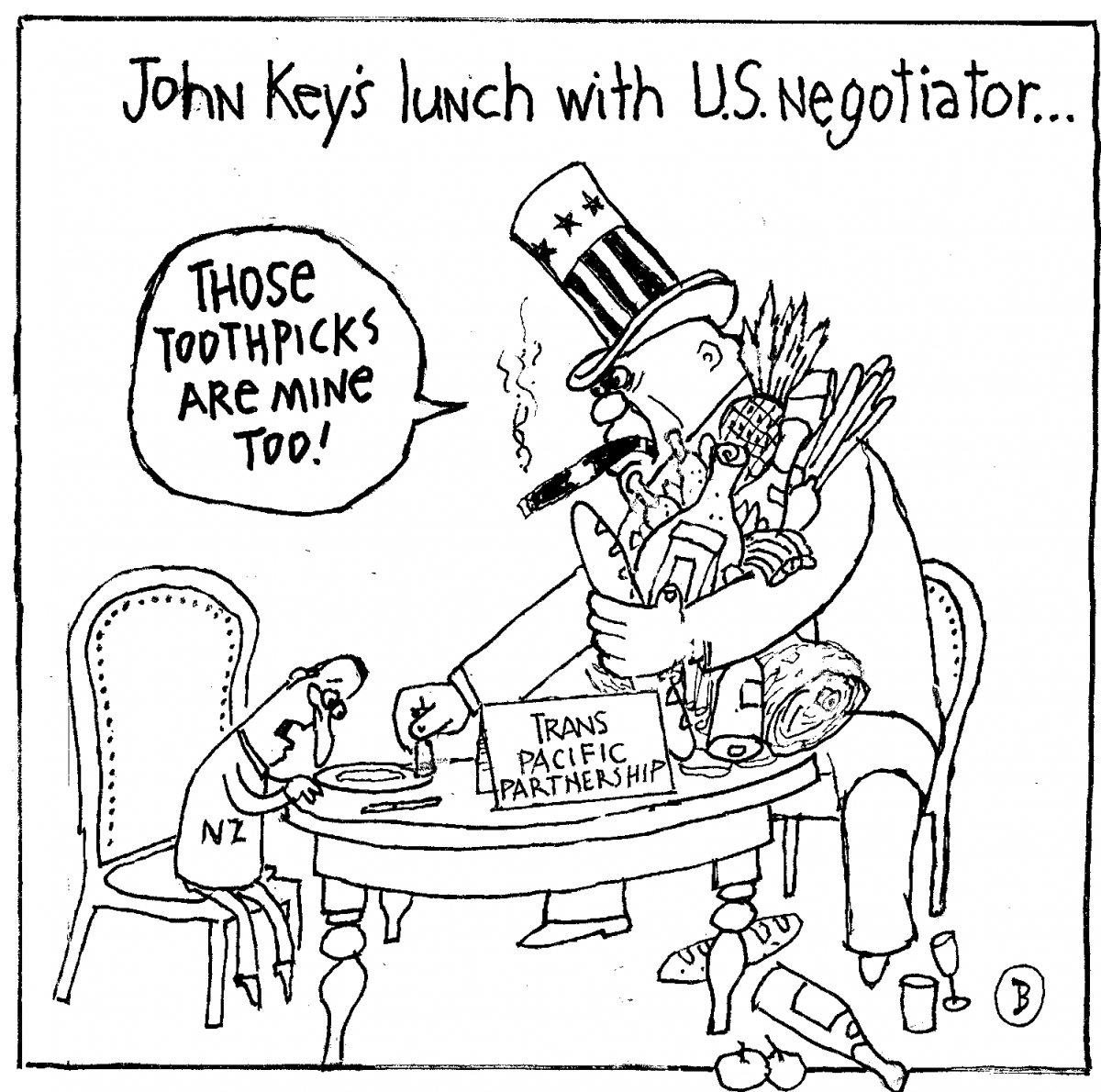 A list of likely consequences of this trade agreement negotiated in secrecy,
collated from a number of sources:
PROFESSOR JANE KELSEY, FACULTY OF LAW, UNIVERSITY OF AUCKLAND warns us "The TPPA will lock future governments into a failed regime where markets rule for the next 100 years." See http://www.itsourfuture.org.nz/th_gallery/professor-jane-kelsey-faculty-of-law-university-of-auckland/
1. TPPA could be used to force Australia to adopt lower standards for e.g., environmental and workers protection, or be sued for damages.
2. The TPPA creates a parallel legal system of international tribunals that will undermine national sovereignty and allow conglomerates to sue countries for laws that infringe on their profits.
3. The TPPA would grant radical new political powers to multinational corporations
4. Under the TPPA democracies might no longer be able to decide to invest tax dollars to create jobs at home or to create markets for green energy or morally produced goods.
5. If the TPPA is signed off in its current form by an Abbott government there will be almost no progressive movement or campaign in Australia whose goals are not threatened
6. Under the TPPA, vast swaths of public-interest policy achieved through decades of struggle are poised to be undermined by Corporations wanting to pursue their business models unimpeded
7. The TPPA provisions are targeted at barriers to corporate business such as the regulation of corporate activities by governments, laws around workplace rights and justice, environmental protection and public health
8. The TPPA provisions empower companies to challenge environmental and healthcare regulations where these impede their business model
9. The TPPA highlights the many inconsistencies and special interests that dominate our approach to trade, which tends to be framed around a relentlessly neoliberal paradigm
10. Under the TPPA, labeling of GE foods for example would be banned in the interest of the harmonisation of laws between countries. The same for labeling the country of origin on food products. Present tobacco and cigarette rulings could be overridden
11. The TPPA puts at risk some of the most fundamental rights that enable access to knowledge by the world's citizens
12. If an Abbott government signs off on these TPPA provisions, they will be set in concrete so that they cannot be changed or modified later even when governments or the public demand change
13. The TPPA represents an unprecedented shift of power towards locking in corporate rule insulated against the normal means of democratic accountability, such as elections, advocacy and public protest
14. The TPPA would establish new rights for foreign investors to acquire land, natural resources, factories and more. All local performance requirements, including domestic content rules, would be overridden by the trade agreement.