
Logan and Albert Conservation Association

A Wildlife Workshop on the topic of "the role of the amateur naturalist in science and conservation" was held on 7 June 2008. This event was hosted by Wildlife Tourism Australia with speakers from both Logan and Albert Conservation Association LACA and WTA.
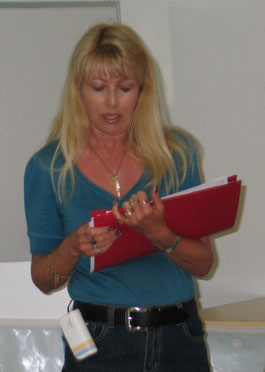 Tricia Belcher, a professional nature photographer
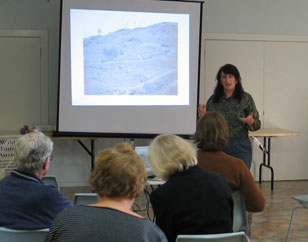 as first speaker described her interest in nature photography and its importance to document animal and plant life for a number of reasons.
She displayed a number of her photographs in particular their importance in relation to documenting events such as the recent aerial spraying incident in Kerry Valley that has had such devastating effects on the environment.
Local zoologist Ronda Green delivered an informative address. She is particularly keen to establish a local natural history group to encourage and support wider community observation and recording skills of our sometimes elusive wildlife. More information will be posted soon. You can contact Ronda Green at This email address is being protected from spambots. You need JavaScript enabled to view it. or 5544 1283 if interested.
Brett Raguse MP Federal Member for Forde launched the inaugural Forde Queensland Day Awards.
Logan and Albert Conservation Association LACA was 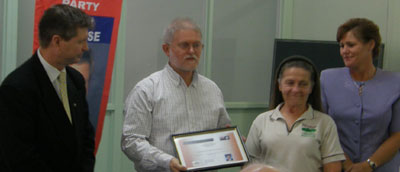 nominated for the 2008 Forde Queensland Day Awards - in the Community Group of the Year Category and LACA has been successful.
Brett Raguse presented certificates at the Forde Queensland Day Awards ceremony Friday 6 June in Beaudesert at the Old Bank Building, Brisbane St. CONGRATULATIONS TO ALL THE MEMBERS of our local envirvonment centre and community group for your dedication to actions to achieve better environmental outcomes.
Left to right: Brett Raguse MP, Andy Grodecki President LACA, Kathy Faldt and Jennifer Sanders.
Congratulations to other community groups and individuals whose contributions were also recognised by our local federal minister.
Friday, 28 March 2008 Transcript of an address given March 4 to the Brisbane Institute by the Honourable Andrew McNamara, Queensland Minister for Sustainability, Climate Change and Innovation.
I'd like to pay my respects to the traditional owners of the land on which we gather this evening.
I want to thank the Board of the Brisbane Institute for the invitation to address this gathering.
Tonight I want to talk about capital S Sustainability.
By that I don't mean the usual narrow environmental concept of sustainability in agricultural production and land use.
I mean the future of our society, our economy and our environment; the structure of our cities, their energy and water sources and demand profiles; the treatment of these sources of our wealth; the imminent peaking of world oil supplies; our use of finite resources like gas and coal; and the way we dispose of those resources when we're finished with them.
I will begin by considering what sustainability means to me.
The full transcript is available at the website of ASPO Australia: Australian Association for the study of Peak Oil and Gas.
A Big Fix: Radical solutions for Australia's environmental crisis by Ian Lowe
The warnings from scientists are urgent and unequivocal - our civilisation is unwittingly stepping in front of an ecological lorry that is about to flatten us. We are using resources future generations will need, damaging environmental systems and compromising social stability by increasing the gap between rich and poor.
As Ian Lowe says, 'If civilisation is to survive, this century will have to be a time of dramatic transformation, not just in technological capacity but also in our approach to the natural world - and each other. The road we are travelling now can only end in disaster.' In A Big Fix, this pre-eminent scientist and environmentalist tackles the problem head on and offers far-reaching solutions to our environmental and social crisis. He advocates a fundamental change to our values and social institutions and offers a vision of a healthier society - one that is humane, takes an eco-centric approach, adopts long-term thinking, uses our natural resources responsibly and is informed about the fragility of our natural systems.
Ian Lowe is emeritus professor of science, technology and society at Griffith University and President of the Australian Conservation Foundation
135 x 210 mm, 113 pages, paperback available from New Internationalist Bookshop.
Beautiful closeup photos of male and female Glossy Black Cockatoos (Calyptorhynchus lathami) provide detail of eating methods. Photographed at Kobble Creek, SE Queensland, Australia May 2008. You will have to click on the links to go to flickr.com where community may post and share their photos. Thanks to this photographer for sharing.
Food Connect and Foresters ANA are collaborating to develop an action research project, aimed at identifying and eliminating barriers to local food access and CSA for all people in local communities.
CSA programs operate in SE Queensland and even in the Scenic Rim region. Details will be posted on this website soon.
One of the cornerstones of Community Supported Agriculture (CSA) is shared risk. "The essence of the relationship," as Elizabeth Henderson states in Sharing the Harvest (see a review of the book below) " is the mutual commitment: The people support the farm and share the inherent risks and potential bounty."
When innocent farmer error threatens the harvest
Rachel Bynum and Eric Plaksin have used hay mulch on Waterpenny Farm in Virginia for many years, purchasing from the same trusted grower every year. Early in the 2007 season they noticed that many crops were doing poorly. The problem was finally traced to the mulch: the grower had used Grazon (with the active ingredient picloram), a powerful herbicide that contaminated all of the mulched crops-about half of the farm.
Even those crops that were not destroyed could not be distributed, even if they had wanted to: Selling produce contaminated with picloram, which is not rated for human consumption, is illegal. When the problem became known in the area, 60 people-including many of the couple's 150 CSA shareholders-helped to remove the 50,000 pounds of messy wet hay from 3.5 acres. The couple cancelled two months of their CSA deliveries and offered refunds.
Is this a different kind of case? Maybe, or maybe not. Though there is no suggestion of negligence on the part of the grower, it is a case of farmer-error, not natural disaster. Even so, many of their members seemed to "get it." They were given two options. Some took the 80-percent refund to cover the balance of the season. A 40-percent refund was offered to cover the loss of harvests until the re-start of harvests in August. About half of the membership took a third, unstated, option: They did not accept any refund. Some even complained that this option should have been stated.
At the time of the incident, the growers did not know how long the effects of the contamination would last, or the true extent of the damage. "It felt like a violation," says Rachel. They were angry with themselves: Should they have known, or suspected a problem? "We even got mad at each other. It was hard to know how to go forward." But members have been extra supportive, according to Rachel, which "helped us a lot to get through it...and now we are back in stride."
Rachel and Eric were careful to explain the problem fully and honestly to their membership - and to acknowledge what they didn't know. "Explaining things felt good, even cathartic," Rachel recalls. "It was best to just come to terms with it." This situation was not as obvious and simple as a flood or hail storm. There was a greater obligation to clarify the situation to farm members. Going forward, Rachel and Eric have a new sense of how interconnected the whole community of growers and eaters really is. One question that comes to mind regarding mistakes made by the grower: Where do you draw the line? Unprotected crops in a frost, inadequately irrigated crops in a drought, insufficient response to insect or other pests...any of these could be deemed farmer-error. CSA growers takes on a large responsibility for their members. We owe it to them to be good at it! (Statement by grower).

Rodale Institute is putting its 60 years of sustainable farming experience and extensive research to work to provide farmers with the know-how, tools and techniques they need to succeed; policy-makers the information they need to best support our farmers; and consumers with the resources they need to make informed decisions about the food they buy and eat.
Research from Rodale Institute's ongoing Farming Systems Trials, the longest running research trial comparing organic and non-organic farming in the United States, also shows that regenerative farming methods can curb global warming, improve the nutrient value of food and prevent famine when farmers use these affordable and sustainable techniques
YouTube - Glossy Black Cockatoo feeding in the wild. Glossy Black Cockatoo (Calyptorhynchus lathami) in the Blue Mountains feeding in Casuraina. This web tool allows us to share our captured moments. Thank you for posting. Glossy Blacks are classified as vulnerable in SEQ. Since they only eat she oaks they are greatly affected by habitat loss.
One of the greatest values of local newspapers and media lies in their willingness to publish letters to the editor presenting all viewpoints. The aerial spraying events at Kerry Valley and Darlington State School will be the subject of discussion for some time. Some letters follow.
Relocalization is a strategy that communities globally are embracing in response to meeting the challenges of living sustainably on our shared planet.