
Logan and Albert Conservation Association
 SEQ WATER STRATEGY - HAVE YOUR SAY!
The Queensland Water Commission's (QWC) 50 year water supply strategy is nearing the end of its consultation phase. You can read it on the QWC website at www.qwc.qld.gov.au/SEQWS. Public submissions are due by the 31 July.
We encourage you to lodge a submission, as the more submissions QWC receive the more they will take notice of community concerns.
 SNEAKY politics had a win at Logan City Council's ordinary meeting last week.
But more importantly, ratepayers got their first true glimpse since the new council was sworn in of how politics is played in Logan City, and the picture painted was not pretty.
Deputy Mayor Russell Lutton's successful attempt to bypass debate and alter the recommendations attached to a confidential planning and development committee item should alarm Logan City ratepayers. Obviously unwilling to accept the recommendations put forward, Cr Lutton rallied enough votes to have a previous set of recommendations reinstated and the new recommendations dumped.
Some may say ‘that is democracy' as Cr Lutton had the numbers on the day, but it was the way the Deputy Mayor went about having the recommendations altered which is cause for concern. His latest move ensures relations between two factions which have appeared within Logan City Council will remain frosty. It also raises questions as to why Cr Lutton felt no additional debate was required on what most councillors have described as an item likely to have a "significant" impact on the city's growth.
Crs 'gagged' By Henry Tuttiett This email address is being protected from spambots. You need JavaScript enabled to view it.  THE veil of unity at Logan City Council has been shed as infighting between councillors boiled over during debate on a confidential planning and development report last week.
Although the report remains confidential, Jimboomba Times understands it concerns a submission to the State Government including information on the future development of North MacLean .
The report was titled 'Growth Management Core Matters' and was confidential under section 463 (l)(h) of the Local Government Act 1993 which states, "other business for which a public discussion would be likely to prejudice the interests of the local government or someone else, or enable a person to gain a financial advantage".
Division 11 Councillor Hajnal Ban accused Deputy Mayor Russell Lutton of intentionally gagging the debate after he moved a procedural motion on the confidential planning report.
The details could not be debated in open council due to the confidential nature of the report and the motion was adopted.
The motion made redundant a set of recommendations previously agreed upon by councillors, instead reverting to the original recommendations.
The move created immediate unrest among councillor ranks with Crs Ban, Darren Power and Aidan McLindon recording their dissent against the motion and Sean Black recording his against the entire planning and development report.
Cr Ban said she was disgusted at how the issue was handled.
"I am not going to speak about anything in the report because obviously it's confidential," Cr Ban said
."But I think the way this was handled was deplorable. It makes a mockery of the local government process and democracy.
"Cr Ban said Cr Lutton intentionally moved the motion to block debate on the item, which she called "significant".
"I am disgusted the Deputy Mayor would move a motion which effectively gagged debate," she said.
"It didn't even allow the opportunity to move into closed session to debate. He was well within his right to do so but I don't think that item, as significant as it is should have been handled that way." .
Despite the report's confidential status, Cr Black hinted it had major implications for North MacLean.
"The biggest fear I have is I don't support the North MacLean precinct, where it's at," Cr Black said.
"It's not worth destroying the lives of the people living there. The revolting way the whole issue has been handled by council, long term, will be viewed by the public in a very poor light.
"The way it's been handled will enrage the community. It enraged me."
Cr McLindon said Cr Lutton's motion was politically motivated and unethical.
"At the executive (meeting prior to the ordinary meeting) we had all the amendments in front of us and everyone was happy. It's legal what they did but I don't think it was ethical."
Despite the motion, Cr McLindon said he did not think the report should have been confidential in the first place.
"It's secret politics and I don't like it at all," he said.
Planning and development committee chair Cr Cherie Dalley declined to comment while Cr Lutton did not return phone calls from Jimboomba Times.
• Editorial, page 32
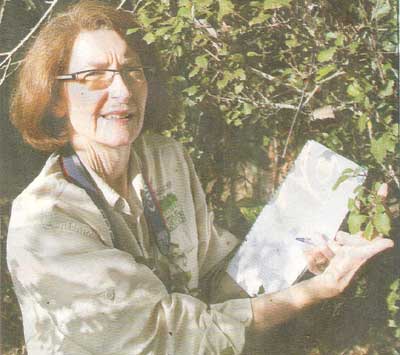 Jimboomba Times reporter recently visited and spoke with Logan and Albert Conservation Association Project Officer Carla Parker on site at Cedar Vale where some precious remnants remain. A copy of the newspaper story follows.
PROTECTION FOR SCRUB
A FRAGILE ecosystem based around endangered dry vine scrub species has attracted a Logan City Council grant to help protect the remaining pockets of scrub. The Logan and Albert Conservation Association was awarded $5000 to produce a colour brochure containing information on how to identify and protect the scrub.
Project coordinator Carla Parker said there was very little of the scrub left, although small patches could be found in Cedar Vale, Veresdale and surrounding areas."With development, that's eliminated a lot, as you can imagine, but there is still little patches of it left and we'd love people to recognise that and to try and preserve what we've got, because once it's gone, you can't get it back," Ms Parker said.
She said the brochure would help people who may have the scrub on their property, but did not recognise it or know what to do about it.
"The project is about informing, educating the community about what we have here, and to recognise it, protect it and encourage it," Ms Parker said.
"In this brochure we will be suggesting how to manage, to assist our wildlife, because they have to be sustained by what native vegetation we leave.
"We'll be giving people suggestions on wildlife friendly fencing, for example."
A late 2005 Beaudesert Shire Council report noted the Veresdale scrub originally covered about 7000ha from Cedar Vale to Waters Creek but only 4ha, or 0.06 per cent, remained.
The community services committee report noted the 1.48ha Champney reserve was considered one of the most biologically significant patches of bushland in the shire and contained 74 native plant species including one that was presumed extinct until the 1980s.
Ms Parker said the brochure would be distributed in numerous ways including letterbox drops and through information centres.
"It will encourage the community to manage this environment more sustainably and assist in retaining the natural environment, lifestyle, and amenity of Logan country and contribute to community wellbeing," Ms Parker said.
"If you've got pleasant surroundings - not just bricks and tin roofs - obviously that's got to make you feel better inside."
Carla Parker identifies plant species at the Champney's dry vine scrub reserve in Cedar Vale.
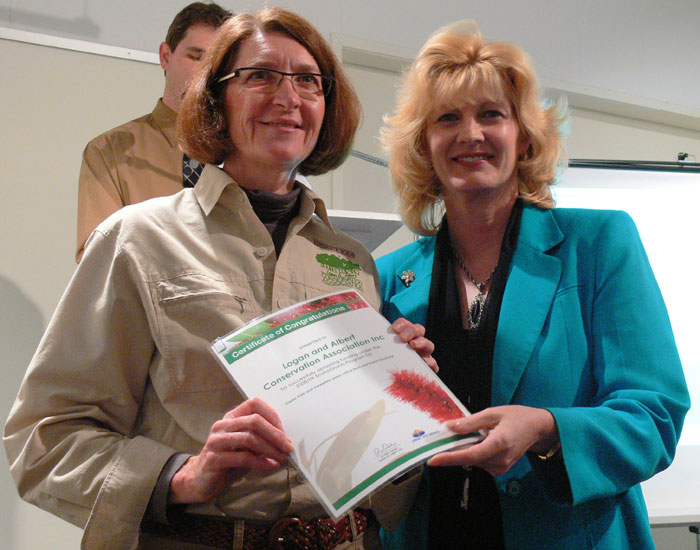 Logan City Council recently recognised and awarded Logan and Albert Conservation Association's valuable long term restoration project in the endangered remnant dry vine scrub rainforest. Our group has received funding to continue surveys of flora and fauna and present that information in brochure format for the local community especially. Project Manager Carla Parker proudly received the certificate and cheque at the presentation event. Mayor Cr Pam Parker made the presentation. 25 groups in all received recognition and funding.
If you are interested to follow discussions and decisions made by council concerning Environment and Sustainability issues, one way is to read the minutes of meetings. Council in May agreed to participate in EPAs Koala Habitat Mapping program and also a Queensland University research project called Conserving species in Human Modified Landscapes. The document for the committee meeting Tuesday 27 May 2008 is available on Logan's website.
The minutes of the previous meeting, available here contains discussion about State of Environment Queensland 2007.
The release of the report was widely reported in the media with the key issue of our ecological footprint being 7.19 global hectares which is three and a half times the world average. Whilst it states that this is 2% less than the Australian average, it must be recognised that this is very much a consumption based measure and the Australian average reflects more on the higher consumption rates of major cities such as Sydney and Melbourne.
Other key issues of relevance include:-
• Queensland's greenhouse gas emissions increased by 4.9% from 1999 to 2004 despite the reduction in tree clearing which contributed a fall of 26.2% for that sector of the emissions.
• Air quality remains good with few exceedences of the Air National Environment Protection Measure (NEPM) and where they occurred in SEQ it was the result of essential burning programs and bushfires.
• Atmospheric concentrations of Ozone depleting substances continue to fall.
• The States wetlands continue to be lost at the rate of 7,000 hectares per year.
• Salinity is expected to affect 3.1 Million hectares by 2050.
• The Brisbane and Logan estuaries are reported for poor water quality.
• Point source discharges of nitrogen and phosphorus have reduced slightly but no data is available on diffuse discharges.
Meeting dates are available online here.
 The following was obtained from a recent CSIRO newsletter Science by Email 27 June 2008 available free by subscription. See current issue here.
Seeing our native fauna lying injured - or dead - on the side of our roads is an all too common sight. It is an unfortunate reminder that the wilderness surrounding our cities is often little more than islands of habitat, making it risky for animals to move about.
In the past, a solution has been to erect a series of nets spanning the width of the highways - a lofty pedestrian crossing for possums. While there is some evidence that animals will use these walkways, only recently has this been studied in detail.
Ecologist Rodney van der Ree, from the Australian Research Centre for Urban Ecology, has completed the first study investigating the behaviour of animals in a habitat prior to a bridge being constructed. "We've been able to measure the extent of the problem before the bridge went up," Rodney says.
Using radio tagging, a range of marsupials - including several types of possum - were tracked for six months near the Hume Highway in Victoria. Their movements across the highway were recorded.
The tiny squirrel glider was the only animal studied capable of gliding between trees. It was found that it only crossed the road where large trees were grown on the highway's median strip. Other animals, such as brushtail possums, simply did not cross at all.
Reduced movement in a habitat can destroy entire populations of native species. Without the ability to relocate, groups of fauna are threatened by diseases that can spread rapidly. For threatened species, such as the sugar glider, this could make a significant impact on their numbers.
While the study is not yet complete, early results indicate that many animals are making use of the rope bridges. For example, some ringtail possums have been recorded crossing the walkways up to fifty times over six months. Others, such as brushtail possums and sugar gliders, have been seen making partial crossings. A number of other animals such as magpies, spiders and geckos have also been spotted on the bridges.
This information will be used to make decisions concerning where future bridges will be built. As more roads are built and more native bushland is affected, knowing how this will impact on our wildlife is becoming increasingly important.
Why did the possum cross the highway?
Because it can do so safely - at least that is what an Australian study into the impact of wildlife rope bridges shows.
He says early results show the animals have acclimatised to the bridge.
Since June last year they have recorded more than 50 crossings of ringtail possums and almost as many partial crossings, seven partial crossings of brushtail possums and four partial crossings by squirrel gliders.
"These early findings are impressive as they show that native animals have acclimatised to the 70 metre rope bridge and are using it to cross the highway to find food, shelter and mates," says van der Ree.
He says the squirrel glider results are particularly positive as they are faced with the threat of extinction in Victoria and New South Wales.
The team will continue to monitor movements for another few years to determine whether population sizes on either side of the highway change and what motivates the animals to use the bridge.
He says climate change will also increase the importance of similar structures as animals will need to move from lowlands to highlands as the temperature increases.
"Ultimately the measure of success is whether the population size on each side of the road increases," he says.
"This is not just about crossing the road, this is about reducing the risk of extinctions."
See some photos and read more here.
The South Australian Supreme Court has ruled that predicted sea level rises are a valid reason to reject beachfront housing developments, in a portent of how climate change could transform town planning along the nation's coastlines. This was reported in The Australian recently. The rejection of a subdivision on Yorke Peninsula, west of Adelaide, is likely to be repeated across the country as councils progressively write climate change provisions into their planning regulations. The South Australian Supreme Court cited local sea level rises of 30cm over the next 50 years in ruling yesterday against Northcape Properties' plans for 80 holiday homes at Marion Bay, 150km west of Adelaide. The changes - which the court ruled was expected, not merely a probability - would encroach on the proposal's "erosion buffer and coastal reserve".
The Australian understands the decision is the first of its kind across the nation, with no other court so pointedly referring to climate change and its effects. The story Coastal plan 'not on the sea level' reports.
In Victoria, GIPPSLAND council is facing a multimillion-dollar class action for damage already done to coastal property values as it weighs banning development in areas vulnerable to rising sea levels caused by climate change. Read the story Coastal shire may face class action.
Permanent Water Conservation Measures have been released for consultation. Closing date for feedback was 17 July 2008.
The proposed permanent water conservation measures and Target 230 are designed to embed the efficient use of water into the everyday lives of SEQ residents out of drought. They will ensure we can enjoy our enviable lifestyle and amenities, but in a water efficient manner. Read the document Permanent Water Conservation Measures here (34p) and the consultation paper here.(14p).
Specifically permanent water conservation measures propose that:
Feedback is being sought from community members and an online survey is provided - with 12 questions for comment.
| Friends of the Koala Friends of the Koala is a non-profit community group run by volunteers dedicated to conserving koalas in the Northern Rivers of New South Wales. Volunteer rehabilitators operate a 24 hour rescue service for sick, injured and orphaned koalas. Koalas are cared for in home care or at the Koala Care Centre on Rifle Range Rd, Lismore, NSW. Critically ill koalas are transferred to the Australian Wildlife Hospital in Beerwah, QLD. A native plant nursery is attached to the Care Centre providing koala food trees for free to local landholders. The proceeds from other native plant sales go towards the cost of koala care. Friends of the Koala plays an active role in promoting habitat restoration in the Northern Rivers Region. This includes encouraging landholders to commit to new plantings and maintaining and looking after remnant vegetation. Although based in NSW this organization's site contains much valuable information. | 27 | ||