
Logan and Albert Conservation Association

Wilderness has entralled man for generations and still does. We may marvel at mankind's innovations and use of technology but we do not always use that technology for improvement. Many have flocked to Canada for the 2010 Olympics. David Suzuki has written...
Those who came to Vancouver for the Games will remember our friendliness and our ability to create a society where people from many backgrounds and cultures can live together. But just as many will remember us for something that has always defined our nation: our spectacular natural environment.
The forests, mountains, rivers, and ocean are visible no matter where you go in Vancouver. The wilderness at Vancouver's doorstep is home to a wide range of plants and animals, especially for a northern temperate region. In much of Canada, you can still find all of the charismatic megafauna that were present at the time of European settlement, including grizzly bears, cougars, wolves, and wolverines.
British Columbia is home to as many as half of Canada's grizzly bears and is one of the Earth's last safe havens for these great animals. In other parts of the world, including Western Europe, Mexico, and the continental U.S., grizzlies and other bears have been driven to extinction or are on the verge of disappearing. Grizzly bears still roam, feed, and breed in much of B.C., whereas in California, this majestic bruin is now only found as an image on the state's flag.
Grizzly bears are an essential part of a healthy ecosystem. Known to scientists as a "keystone" species, grizzlies support plant and forest health by aerating the soil as they dig for roots and pine nuts and by dispersing the seeds of the plants they eat. In coastal ecosystems, such as the Great Bear Rainforest, grizzlies and other carnivores contribute to the magnificence of the landscape through the way they eat salmon. During summer and fall, hundreds of bears congregate along estuaries and rivers to gorge themselves on salmon migrating from the Pacific Ocean to their natal streams to spawn.
Grizzles are messy eaters. As they drag their prey out of the rivers and into the forest, and as they defecate in the woods after feasting on salmon, they help to distribute the nitrogen-rich nutrients from the salmon across the forest floor.
Despite their importance in nature and their vulnerability to human impacts, grizzlies remain unprotected in Canada. Some provinces, such as British Columbia, allow hunters to kill this threatened animal for sport. The trophy-hunting season for grizzlies and other bears in B.C. will open in a few weeks, just as the bears emerge from hibernation.
The extent to which trophy hunters are killing grizzlies in B.C was not fully known until now. The David Suzuki Foundation recently acquired and analyzed thousands of kill records collected by the government. We found that close to 10,000 grizzlies have been legally hunted in B.C. since the government first began tracking kills in the late 1970s. Many hunters come from the United States and Europe, where it is illegal to hunt bears or populations no longer exist.
Our research also shows that trophy hunters are turning many of B.C.'s parks and protected areas into graveyards for bears that are legally slaughtered within park boundaries. We've identified more than 60 provincial parks where grizzly bears are hunted for sport, including Northern Rocky Mountains Park, Spatsizi Plateau Wilderness Park, and Tatshenshini-Alsek Park.
British Columbia has taken steps to protect grizzly habitat by banning some resource activity like logging and mining in protected areas, but these measures are nearly useless without laws that prohibit people from killing bears.
Canadians have always revered the spectacular natural bounty that makes ours one of the most beautiful and prosperous nations on Earth. The prominence given to old-growth forests, salmon, and bears in the opening and closing ceremonies of the Olympic Games in Vancouver demonstrates how important nature is to our national identity and our desire for others to see us as a modern Eden. Yet with this richness comes responsibility.
Ironically, the strongest protection for grizzly bears exists outside of Canada, in places like Mexico where they are no longer found. Canada's wildlife is worth much more than just being an Olympic mascot or a marketing brand to sell to tourists - or a trophy on someone's wall.
In New South Wales the Rifle Sportsman Association has recently been lobbying government to allow its members to shoot 'feral' animals in National Parks and shooting of ducks and flying foxes is still allowed - in season. Surplus animals bred for zoo stock have also been targeted for trophy hunting. The use of firearms for recreational hunting for sport is scarcely justifable in our 21st century world where we now know better the interrelationship of species and the rate of extinction of many species.
Likewise in South East Queensland we are responsible for the feared extinction of our iconic koala. We are destroying the habitat and home of the unique koala to build housing and infrastructure for the expanding human population. While shooting is illegal some have escaped consequences for so doing.
Unless we protect the bushland habitats of the native animals, they will die out within the decade - as surely as we shot them in thousands last century.
KOALA SIGHTINGS (Browns Plains to Veresdale Scrub, Yatala to Ipswich City)
T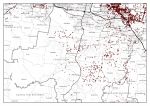 he koala sightings in the map shown (click to enlarge) have been reported to WILDNET (Department of Environment and Resource Management) by the community and other scientific experts, and are current to June 2009 and include historically observations as well. The koala population in the Mount Lindesay North Beaudesert area have NEVER been properly surveyed by any local council or by state government and these WILDNET sightings provide very valuable information for the local area when no other detailed studies have been undertaken.
LACA encourages the community to continue to report their valuable wildlife sightings from their local area or from other areas the community may visit.
PROPOSED ENERGEX POWERLINE ROUTE - CAMP CABLE RD / WATERFORD-TAMBORINE RD /
LOGAN RIVER / LOGAN RESERVE RD and KOALAS
This WILDNET map reveals that there are numerous sightings of koalas to the north and south of Camp Cable Rd and east and west of Waterford -Tamborine Rd. RSPCA and residents have reported collecting dead and injured koalas from the vicinity of the new Camp Cable Rd and surrounding areas. There are already existing cleared easements for Powerlink easements ( north of Camp Cable Rd) and Energex easements (south of Camp Cable Rd) that create barriers for koala movement and increase the length of time that koalas may spend moving over open ground and therefore place koalas at greater risk of cars and dog attack. Local residents along Camp Cable Rd have already noted a decline in visits by native animals as a result of the construction of the new alignment for Camp Cable Rd a few years ago. Energex's own IAR report from June 2009 acknowledges that current powerline easements already fragment habitat and this proposed route will continue to fragment and degrade the habitat further with further negative impacts on local and regional significant fauna species such as koalas.
Can Queensland continue to welcome the thousands of people each week who want to move here?
Will our infrastructure cope or are those calling for a population cap threatening the state's jobs growth?
Will we all have to get used to living closer to each other in higher density suburbs?
The State Government is gearing up for a population growth summit on March 30 and 31.
Panel members:
Professor Paul Burton: Deputy Director, and Chair of Urban Management - Gold Coast, Griffith University Urban Research Program.
Najda Kunz: Nadja holds a dual degree in chemical engineering and business management. She is a member of both the Queensland Youth Environment Council (QYEC) and Engineers without Borders.
Councillor Pam Parker: Mayor of Logan City. As Logan City's first female Mayor, she is drawing on her long-term Council experience and rapport with the community to cater for the city's 261,000 residents and plan for the city's future.
Brian Stewart: Brian is the CEO (Qld.) Urban Dervelopment Institute of Australia.
Register your attendance by emailing your name and contact details to: This email address is being protected from spambots. You need JavaScript enabled to view it..
Click here for campus map including parking locations
Andrew McNamara who served three terms in the Queensland Parliament as Member for Hervey Bay between 2001 and 2009 and was Minister for Sustainability, Climate Change and Innovation in the previous term of the Bligh Government wrote
The failure to recognize and confront the danger of exponential population growth now transcends every other problem that confronts us. The idea that the world's population will be "stable" at 9 or 10 billion is ludicrous, as we watch refugee flows ramping up as a result of water and food shortages now. The answers to the issues of climate change, food security, energy security and water security cannot be found without acknowledging one simple fact.
If you are attending the forum please consider your mode of transportation and lessen impacts of your journey. Hope to see you there!
.
INVITATION to PUBLIC MEETING
Monday 22 February 2010
Jimboomba Tavern
6:30-8:30pm
Cnr Mt Lindesay Highway & Cusack Lane JIMBOOMBA
There are signifigant patches of Melaleuca Irbyana in the Jimboomba and surrounding areas. Use of the phrase Swamp Tea-tree Forest is not common - but indicates that more than the single species has federal protection. No species - plant or animal - exists in isolation but is part of an interconnected web - much of which the lay person may not know about.
Are you a landholder - or caring tenant - with this endangered ecological group of plants?
You are most cordially invited to an Information Session to find out about these vegetation types, the legislation protecting them and the opportunities available to assist with their management. Questions such as:
What is the significance of having endangered Brigalow or Swamp Tea-tree Forest on your property? will be addressed.
The following specialists will be on hand to brief you about the project and to answer any further questions you may have: Liz Gould: Environment Sector Partnerships Manager - SEQC - South East Queenlsland Catchments Association.
For catering purposes please RSVP
Ben Barton, Community Contact Officer Bremer, SEQ Catchments, West Ipswich Q 4305 Ph 07 3816 9721 Fax 07 3812 8685
This event is being co-hosted by Logan City Council, SEQ Catchments and LACA - Logan and Albert Conservation Association.
2010 SPOTLIGHT ON WILDLIFE IN SCENIC RIM - series of community workshops sponsored by SRRC
 To help celebrate the 2010 United Nations International year of Biodiversity , the Logan and Albert Conservation Association will be hosting a series of free public workshops entitled 'Spotlight on Wildlife in the Scenic Rim'. The workshops have been funded through a Community Environment Assistance Grant from the Scenic Rim Regional Council.
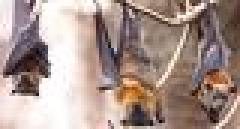
The first 2010 WORKSHOP will be held in Canungra where there is a significant colony of bats and where recently there was a crisis to save the babies after a storm devestated their usual bat family nursery habitat. The workshop will help us all to become more aware of the signifigant contributions this family of flying marsupials makes to our shared environment and how we can all live safely and harmoniously together.
The Canungra workshop will include guest speakers Louise Saunders from Bat Care Brisbane Inc, Janet Gamble from the wildlife section of the RSPCA and local zoologist Ronda Green.
 The world we share with other species of nature - all co-existing on the one plant and sharing the same biosphere - has many life skills to share with us - if we can only see and understand. Tom McKeag who teaches bio-inspired design at the California College of the Arts and University of California, Berkeley has nominated his 2009 Tommy Awards.
He has also decided to give the awards to the creatures that inspired the innovation, rather than the human inventors. This is an amazing new non-destructive application of technology and a whole new world for design.
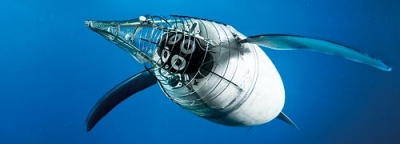
The penguin, in the strictest biomechanical sense, doesn't really swim underwater, but rather flies. That is, the creature gets both lift and thrust from the action of its flapping, planar wings. It has inspired the latest development in robots highlighted by the German engineering firm Festo AG at the Hanover Messe Trade Exhibition in April.
The Aquapenguin mimics the hydrodynamic body features of the bird and is made with soft material and glass fibre rods, a motor and 3D sonar device by Evologics of Berlin. These allow the bot to swim with great flexibility and avoid collisions with obstacles or other swimmers, important in situations demanding a high degree of flexibility and autonomy. Festo has already developed a commercial product, an industrial arm with a gripper end, based on this technology.
UN Secretary General Welcome Message for the 2010 International Year of Biodiversity from CBD on Vimeo.
The United Nations declared 2010 to be the International Year of Biodiversity. At the Johannesburg Summit 2002 the international community set itself the goal of making a "substantial reduction in the rate of loss of biological diversity" by 2010 but this is not happening. In fact biologists talk about sixth extinction wave and they estimate that the rate of species extinction is about 1,000 times higher than the natural background rate, mostly because of human activities: habitat loss, exploitation and climate change.
Janine Benyus shares nature's designs
Transcript of a TED TALK
It is a thrill to be here at a conference that's devoted to "Inspired by Nature" -- you can imagine. And I'm also thrilled to be in the foreplay section. Did you notice this section is foreplay? Because I get to talk about one of my favorite critters, which is the Western Grebe. You haven't lived until you've seen these guys do their courtship dance.
Professor Jonathan Hill, the head of the school of Veterinary Science at the University of Queensland, says once a Hendra virus quarantine has been lifted, any concern about any of the horses on property where Hendra virus had been is misplaced. It is indeed uncessary misfortune to have sound horses devalued as a result of exposure. When people who contact or walk into infectious diseases and don't get the disease, we know that they are not infected. Professor Jonathan Hill says the horses are not damaged goods just because they have been on a stud which had horses that had Hendra virus. In fact you could say that they have been tested to be 100 per cent certain of being clear, which puts them in a unique spot.
Professor Hill says such misconceptions stem from a lack of knowledge about Hendra virus, which need to be addressed with research.
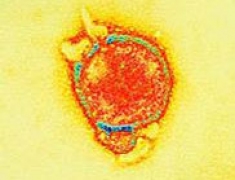 CSIRO scientist Dr Deborah Middleton works in the field of Transforming Animal Biosecurity - Livestock Industries and she is the theme leader for this reseach.The research results are published online in the very scientific journal plospathogens or it is available from links as part of the media release. ABC news reported on this 31 October 2009.
The CSIRO is claiming a breakthrough in the battle against the deadly Hendra virus.
A scientific team from the CSIRO and the United States has developed a serum which gives a good level of protection to ferrets exposed to the similar Nipah virus.
They demonstrated that administering human monoclonal antibodies after exposure to Nipah virus protected the animals.
The CSIRO's Dr Deborah Middleton, who led the experiments at Geelong's maximum biosecurity facility, says the findings are extremely encouraging. "Our research clearly suggests that an effective treatment for Hendra virus infections in humans should be possible, given the very strong cross-reactive activity this antibody has against Hendra virus," she said.
"As Hendra and Nipah viruses cause severe disease in humans, a successful application of this antibody as a post-exposure therapy will likely require early intervention."