
Logan and Albert Conservation Association

The Trans-Pacific Partnership Agreement:
Potentially the greatest threat yet to our environment,
social justice, health system and democracy
This could represent an unstoppable threat to our environmental laws, our way of life, our democratic rights, our legal system, our health system, our internet use, our tobacco plain packaging laws, etc, etc. If certain provisions in this trade deal, currently being negotiated in extreme secrecy, are agreed to by a future Coalition Government then Australian communities will have little power to stop any foreign corporation from doing what it wants, where it wants, including moving them out of the way, if necessary. This is a real concern because these clauses, known as 'Investor-State Dispute Settlement' provisions, fit comfortably within increasingly right wing Coalition ideologies under Tony Abbott.
Do you want an Australia in which major international Corporations can sue the Australian government for making laws which are aimed at protecting farmland, water quality, rainforests, the Great Barrier Reef etc?
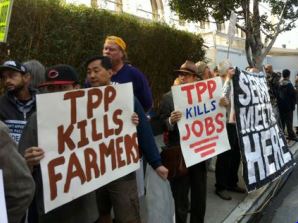 Do you want Australia to sign an international trade agreement which will potentially wreck our Pharmaceutical Benefits Scheme (making chronically ill Australians pay top dollar for medicines), force farmers off their land through agricultural dumping, get Australians jailed under US copyright law for innocently downloading research material on the internet?
What is it?
This is the Trans pacific Partnership Agreement (TPPA) – free trade negotiations currently being held in high secrecy between Australia, Brunei, Chile, Singapore, Malaysia, New Zealand, Peru, the US, Vietnam, Canada and Mexico. Other nations, including Japan and possibly China, are set to join. The negotiations have been going on for a number of years but the agreement is proposed to be signed off soon – possibly in October this year. An excellent summary of the environmental and other issues that may flow from this trade agreement can be found in:
http://www.citizenstrade.org/ctc/wp-content/uploads/2012/03/TransPacificEnvironment.pdf and http://www.citizenstrade.org/ctc/wp-content/uploads/2012/03/TransPacificCorporations.pdf
Ring the State Government hotline on 1800 600 163 for information on Key Resource Areas.
Make a submission by Wednesday 12 June 2013 5pm
SOME QUESTIONS ASKED AND ANSWERED
Should our local council be consulting with the community when the council is preparing its response to the draft SPP?
When Council is undertaking a new planning scheme, they are required to consider all of the state's interests as outlined in the SPP and apply them in a local context; during this process council must extensively consult with the community on these matters, such as KRAs.
It is not appropriate or required under the Sustainable Planning Act 2009, for local councils to undertake community consultation in preparation of their response to the draft SPP. As mentioned we encourage everyone and anyone to provide a submission by the June 12 due date to ensure that your views are heard.
Further to this, the Mayor of Scenic Rim Regional Council Cr John Brent, has provided a statement regarding the draft SPP and in particular concerns around the proposed KRAs. It can be found on the Beaudesert Times website: http://www.beaudeserttimes.com.au/beaudesert/218-mayoral-statement and may be of assistance.
While it is pleasing to see the Mayor acknowledge the Council's Community Plan, developed in partnership with the local community over a period of 18 months, which captures residents' vision and aspirations for the Scenic Rim during the next 15 years and we ie council are guided by the values detailed in this document, there is an escape clause
The Plan outlines the importance of preserving our natural surroundings, however, this is not to the absolute exclusion of the development and industry needed to help grow this and other regions.
How have the boundaries of the proposed KRAs been determined, especially KRA 140?
The draft SPP Guideline: Mining and extractive resources includes detailed information about what constitutes a state or regionally significant resource and includes information on how separation areas are determined.
The location and boundaries of KRA's are based on the estimated location of the extractive resource of state or regional significance. The draft KRA 140 boundary is based on the location of two high intersecting ridges of basalt.
In the guidelines, a report and a map of each of the proposed KRAs is also included - this provides information on local circumstances which may influence the boundaries of a KRA such as resource type, topography, environmentally sensitive areas etc.
Who has been responsible for deciding which areas are proposed as KRA's?
The Department of Natural Resources and Mines has been undertaking the assessment of potential Key Resource Areas. The location of KRA 140 was determined through a desktop analysis which included the extrapolation of geological data and a review of drilling activities in nearby locations.
Why have two haul routes been nominated for KRA 140 effectively placing restrictions on twice as many properties whose land falls within the 100 metres of the haul route?
Two routes have been identified as potentially appropriate for the KRA area. If an extraction of resources were to be approved by Scenic Rim Regional Council, the applicant would have to identify through research, the most effective and least intrusive haul route.
The transitional development assessment criteria's only applies to land that is 100 metres either side of the centreline of the proposed KRA transport routes. This identification does not change the existing rural uses on land adjacent to the transport route.
What real restrictions are likely to be placed on properties which fall within the separation zone?
The draft SPP proposes that Council ensure that the State's interest in protecting significant extractive resource deposits is appropriately considered in local planning decisions.
The actual conditions imposed on a development or included in the local planning scheme, will vary depending on the local circumstances. As a general rule of thumb, the State's intent is to not increase the number of people who may be adversely impacted by the current or possible future extraction of resources from an identified KRA.
The model code included in the SPP Guideline: Mining and extractive resources (Appendix 2) gives an example of the provisions that the State feels are appropriate to be applied to development affected by a KRA. While the state provides this example, it does not mandate requirements. Ultimately the conditions placed on a development application are the responsibility of the local council.
We trust this information is of assistance, if you have any further questions or concerns regarding the SPP please do not hesitate to contact the SPP team on 1800 600 163.
State Planning Policy project team
Department of State Development, Infrastructure and Planning Queensland Government tel 1800 600 163
This email address is being protected from spambots. You need JavaScript enabled to view it.
The draft SPP State Planning Policy identifies the state's interests in planning and development and how these are to be dealt with in planning instruments, council development assessment processes and in designating land for community infrastructure.
It will provide the tools to empower and support local governments to make the right planning decisions for their community and to implement state interests in the way that best suits their community needs.
An integrated mapping system is being developed to visually represent the state's interests and will be available with the final SPP, which is expected to come into effect in the second half of this year.
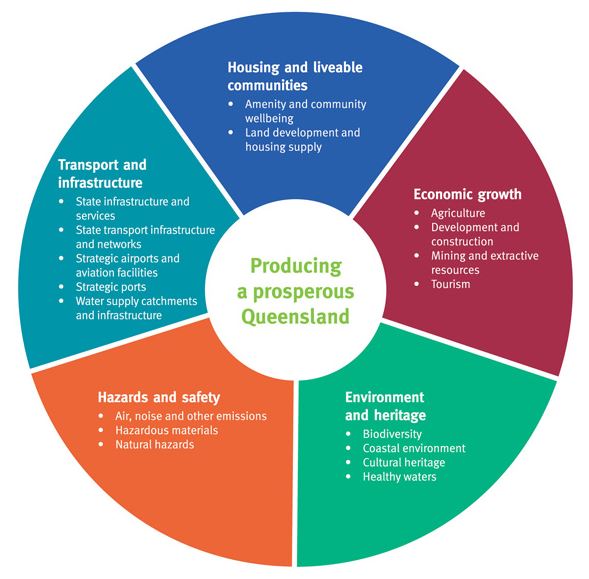 Having your say - by Wednesday 12 June
As a statutory consultation process, the Minister must consider all submissions, so the best way for people to make their views known is through a formal written submission.
To provide a properly made submission you are required to:
- include the name and residential or business address of the submitter
- be made in writing, and unless submitted electronically, must be signed by each person who has made the submission.
Forward your submission to:
Post: State Planning Policy feedback
Department of State Development, Infrastructure and Planning
Reply Paid 15009
City East Brisbane QLD 4002
Fax: +61 7 3237 1812
Email: This email address is being protected from spambots. You need JavaScript enabled to view it.
You can also continue to speak directly to the SPP team regarding your concerns through the dedicated email This email address is being protected from spambots. You need JavaScript enabled to view it. and/or hotline 1800 600 163.
Designating land for community infrastructure includes such projects as power infrastructure eg POWERLINK's multi million dollar line to mining operations was deemed to be community infrastructure as is the SFRC Southern Freight Rail Corridor
Economic growth government believes will come from
How will the KRAs impact on the program known as National Landscapes ? Managed by Tourism Australia and Parks Australia, the National Landscapes program focuses on the development and marketing of Australia's 15 most significant, world class natural areas. The program aims to provide visitors with new and engaging experiences to increase visitation, dispersal and length of stay within Australia's most unique natural environments. Queensland's three National Landscapes include the World Heritage listed Wet Tropics, the Great Barrier Reef and Australia's Green Cauldron (more commonly known as the Gondwana Rainforest Reserves of Australia on the Queensland and New South Wales border) in Scenic Rim.
It is challenging to see how all these policies including the SEQ Koala Conservation SPP 2/10 can be improved by a single policy.
Have your say on any aspect of this draft policy.
Information about KRAs is available here  KRA_spp_2_07__training_handout_aug07.pdf
Read our LACA Logan and Albert Conservation Association 2011 objection to Kerry Quarry application - not approved by council and later withdrawn by applicant here LACA-QUARRY-OBJECTION2011.pdf838.82 KB
The Green Army and other crazy ideas
- first published in EcoNews from SCEC May-June 2013
Recent surveys in Australia and the US have found majority support for action on climate change. Clearly, even in these last bastions of climate denial, there is growing acknowledgement that we are facing a frightening future which will demand the employment of the best contemporary knowledge to come up with the most creative solutions, if we are to maintain our quality of life into the future.
But not the Federal Coalition. It is the conservative way to look back to the golden days of the past (and the Tea Party) for policy inspiration, and when you've backed yourself into a corner on carbon pricing with nowhere else to go, why not cobble up a crazy story and try to make it sound believable?
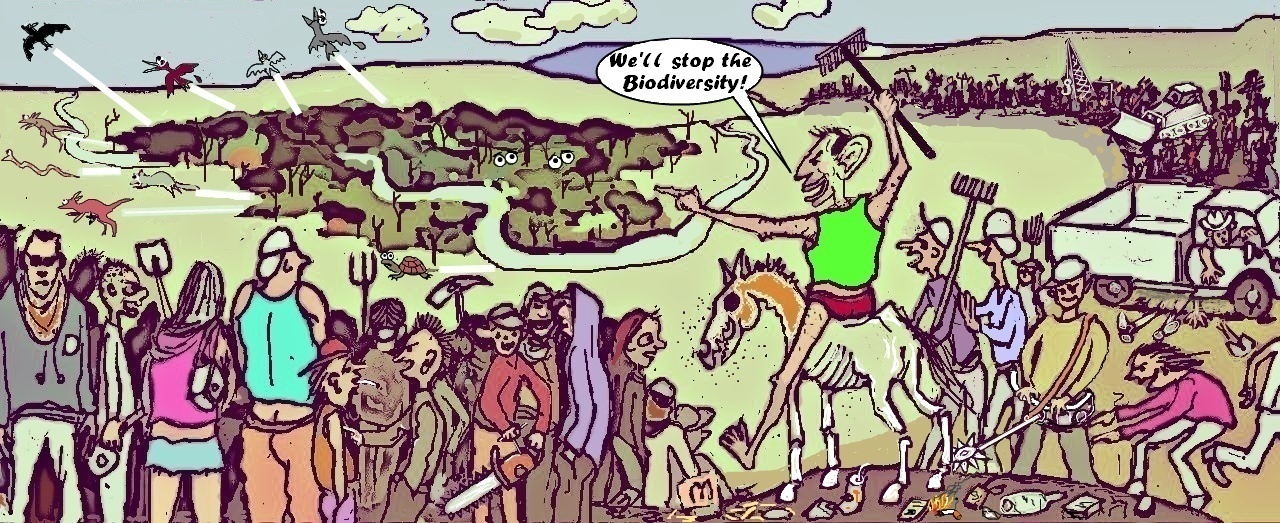
So what better for the Coalition than to reinvent the conservative ideology of 'work for the dole', combine it with Howard's Greencorps, dress it up as carbon reduction, and create a Green Army of 15000 to be recruited from somewhere within the ranks of the unemployed, disenchanted, and confused?
The Green Army is tasked with planting 20 million trees by 2020, and this has become a major plank in the Coalition's 'Direct Action' policy - a title with a swaggering, cut the crap, General McArthurish appeal to those voters who, the Coalition hopes, won't think too much about it. Furthermore, 'Direct Action' echoes notions embodied in the Coalition's 'delivering frontline services' mantra - in this case, doing the carbon abatement 'here, in Australia, where we benefit directly from it'.
All sounding fair enough?
Well, no. The science is becoming far less certain around a second key plank in the Coalition's Direct Action policy - soil carbon's value for carbon sequestration – and economists almost universally condemn a third plank - the competitive grant scheme (effectively a carbon tax in disguise) where the government will buy reverse auction emissions reductions bids from businesses - because it will result in enormous administrative loads and ballooning taxpayer costs.
As a result, the Coalition is finding that its Direct Action solution for carbon reduction is looking shakier than ever (although would-be deputy prime minister Barnaby Joyce still can't see anything wrong with it because it sounds good and... should work anyway, whatever).
To avoid looking too silly the Coalition has quickly advanced the Green Army forward as the flagship solution, particularly for its neat opportunities to create warm fuzzy propaganda about winning community hearts and minds and boot-camping 'lazy' youth, but especially because it will provide endless ministerial photo ops around 'mission accomplished' tree planting events.
If we do try to assume for a moment that the Coalition in Government will be genuine about using the Green Army to help achieve their commitment to a 5% carbon emissions target by 2020, then the deployment of this 'army' will have to be at the very least on the 'shock and awe' scale.
However, military jargon has always specialised in turning gore into glory. This will not be a disciplined army but a loose collection of 'militia', shanghaied for the job of planting 20 million trees by 2020, with a care factor somewhere around zero. And, if the Green Army is genuinely intended to meet its targets, it is the size, scale and speed needed to achieve its objectives that will create ugly problems.
At 15000 strong, the 'Green Army' will be larger than most state police forces, over half the size of the Australian army and similar to the air force and navy, without the supporting infrastructure that these bodies have. It will be composed of young, generally poorly committed novices, learning as they go, conscripted for just six mistake filled months before being replaced by new recruits - their tour of duty terminating just as they might be starting to 'get it'.
And this is one of the core problems. There is nothing wrong with planting lots of trees, but it has to be carried out with science and sympathy because ecosystems are very complex and enormous damage can be done through otherwise well-intentioned restoration schemes.
And the challenge is huge - according to their Direct Action Plan, the Coalition aims to offset 15 million tonnes of emissions by 2020 through tree planting. To achieve this it has been estimated that an area of 25,000 square kilometres will be required, plus about 9,100 GL of water - two and a half times that proposed for the Murray Darling Basin Plan.
So it will not be a trained and disciplined army which will face these impossible challenges, and the collateral damage is likely to be severe. Biodiversity will be the big loser, but also water quality and farming may be impacted, and communities and local councils will be obliged to pick up the pieces. Most pertinently, the objective of sequestering enough carbon to meet the 2020 five per cent carbon reduction target simply cannot be meaningfully assisted by planting 20 million trees in this way, within this time frame.
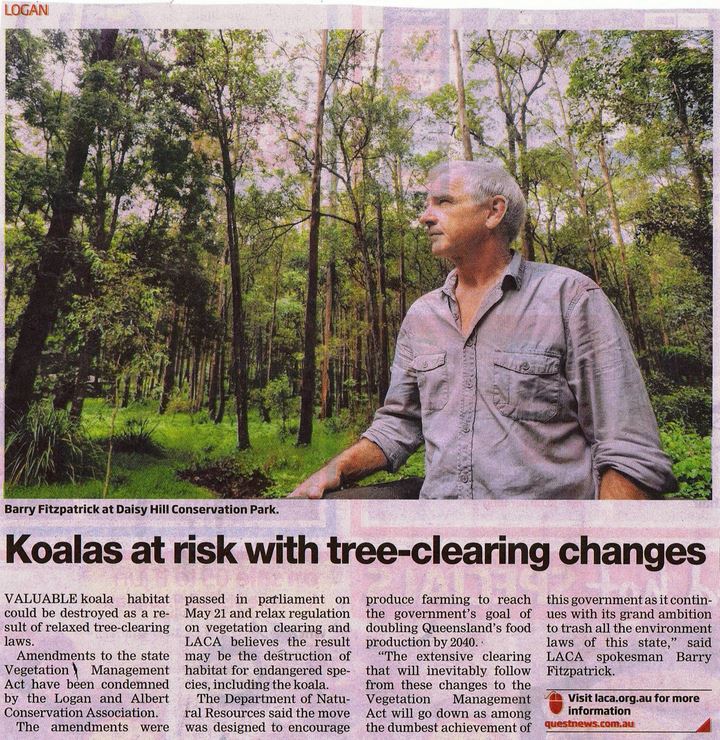
All existing koala habitat is essential for the future well being of Logan's resident koala population. And importantly all populations contribute to the genetic pool for the species and wide diversity is a potential safe guard in the event of a disaster such as bushfires which can deplete a koala population in that area. Though LACA Logan and Albert Conservation Association is advocating here for the iconic koala, this is an umbrella species for all. Without the flying fox - pollinator of eucalypts - only food source for the koala the fate of the koala is not certain. Tree clearing changes introduced by Newman government will we fear have dire consequences
Long term advocate for all environmental issues Barry Fitzpatrick has had an article published in Albert and Logan News. We thank them for publishing our concerns. If you also are concerned make sure that all your elected representative know. Use media eg comment on article in letter to editor, phone write email your local member - at all 3 levels of government.
Importantly also - REPORT ANY and ALL KOALA SIGHTINGS.
Quarry at KERRY renamed as ERIN VIEW KRA
 QAG Quarry Action Group led a well researched and successful campaign to oppose the establishment of a quarry in the rural area of Kerry Valley. Group members were pleased that Scenic Rim council refused the MCU application.
Unfortunately thes members have heard that "if SRRC had their time over, they would approve the Erin View quarry"
The State and Council claim (and it is legally the case) that the KRA designation is separate from the MCU approval process and is not intended to influence council consideration of the MCU. QAG advice is that in practice this is not the case and approval is more likely if a KRA is in place.
In essence the State, under the guise of flagging resources for future use, is via the current KRA process, taking existing property rights from owners and depreciating the value of their land with no compensation while simultaneously passing wealth to the individual or company resource site owners. Sheriff of Nottingham stuff!
The same issues as before are stll relevant - and more so because there are planned to be 5 KRAs in Scenic Rim. Far from being a natural environment visually and emotionally appealing the area will be marred by dust noise and increased road traffic pollution.
The threat of Quarry Central is hanging over the Scenic Rim unless the Scenic Rim Regional Council is prepared to stand with residents and fight for the community-expressed vision for a future based on agriculture, tourism and compatible development. QAG is seeking urgent meetings with Mr Jon Krause, MP, and the Scenic Rim Council.
The five areas cited by the State Government for designation as KRAs are:
- Cryna, an existing quarry recently given approval by the SRRC to nearly treble its output, five kilometres south of Beaudesert.
- Markwell Creek Road (greenfield site) eight kilometres south of Beaudesert.
- Erin View, Kerry (greenfield site) 12 kilometres south of Beaudesert.
- Kangaroo Mountain, four kilometres north of Aratula.
- Yore Road, three kilometres north of Tamborine Village
The immediate impact of a KRA designation on a site, regardless of whether it was ever developed, would very likely be to drive down surrounding land values and restrict the use options of neighbouring properties caught in buffer zones. Separartion areas or buffer zones will surround the quarry area and also along transport corridors. This is not land owned by the quarry site but will restrict what can happen on that land.
See Erin View Lot plan here and Markwell Creek Road (greenfield site) here.
These KRAs are part of the planning and background documents for the state's new approach which means that a single state planning policy has been developed to replace the multiple policies in existence. The draft State Planning Policy (draft SPP) ( 1.5 MB) sets out policies on matters of state interest in relation to planning and development, and provides a key framework for the government's broader commitment to planning reform.
There have been NO COMMUNITY INFORMATION SESSIONS IN SCENIC RIM OR LOGAN CITY. Gold Coast, Ipswich and Brisbane community were offered a session/briefing. The briefing was free, however RSVPs were essential. To request a briefing session, call 1800 600 163 or email This email address is being protected from spambots. You need JavaScript enabled to view it..
See what was presented in Brisbane http://www.dsdip.qld.gov.au/resources/publication/spp-seq-industry-briefing-presentation.pdf
Have your say - until 12 June 2013
 Local governments, the community and other stakeholders are encouraged to have their say on the draft State Planning Policy (SPP) prior to it being finalised later this year.
65 pages of important reading if you care about the
future of SEQ - and Queensland
KRAs are just one 'policy' to be included in SINGLE POLICY to
replace many!
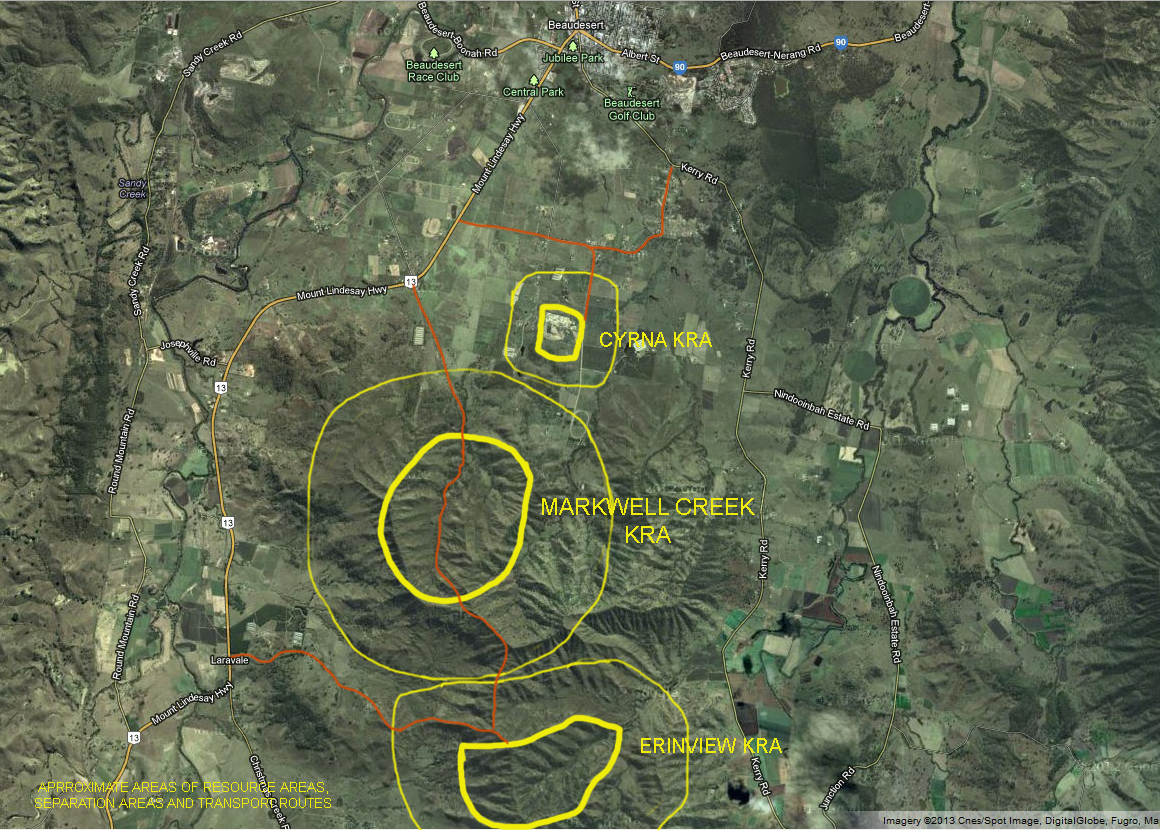
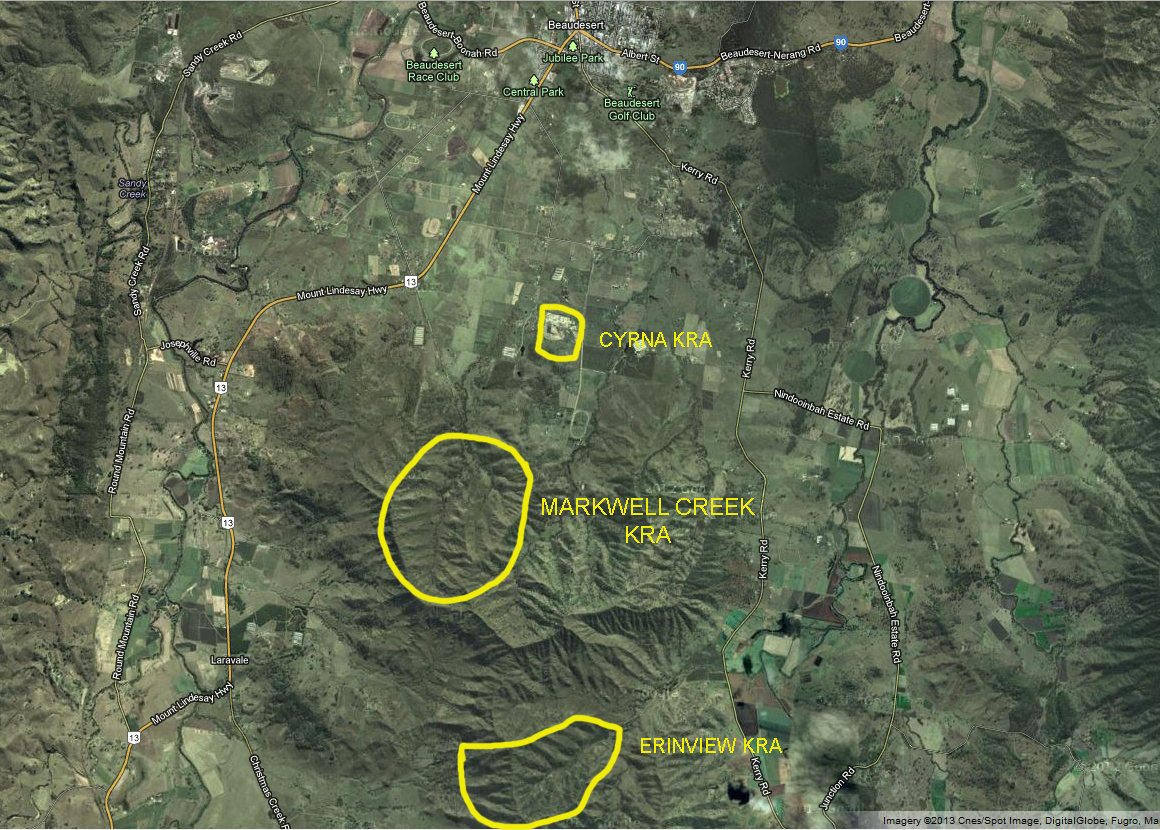
The Kerry Quarry - SRRC rejected in 2012 - has been proposed as the Erin View Key Resource Area ( KRA 140) in addition to several other quarry KRAs for the SRRC and Logan City council areas, including: Markwell Creek Rd KRA 142, Cryna KRA 139, Yore Road KRA 143 ( 3 km south of Clutha Creek KRA), Kangaroo Mountain KRA 141 ( north of Aratuala in habitat containing at least 3 essential habitat factors for the koala). See attached map of 3 KRAs of Erin View, Markwell Creek and Cryna.
If an area is set aside as a KRA it
- does not give automatic approval rights
- it recognises a state or regional resource
-it may limit or restrict what neighbouring property owners can do on their land ( eg in separation zones and buffers around the KRA itself and transport corridors)
- does not take into account amenity impacts or transport impacts that may occur from the designation of a KRA
- the KRAs should have had significant biodiversity, ecological, conservation, cultural heritage and indigenous values assessed as part of the process for defining the boundaries of a KRA - has this been done? Not in the original MCU application for Kerry Quarry.
Concerns already raised by the Kerry community about the proposed Erin View and Markwell KRAs include -
1. SRRC previously received over 1000 objections from the community for the Kerry Quarry - this MCU ( Material change of Use ) was not approved by SRRC in 2011/12.
The community is asking for SRRC to continue to support community and to
say no to this state government draft.
2. Residents and QAG Quarry Action Group have approached some SRRC councillors - the councillors are saying this is not a local government matter , but a state govt matter. If this is designated a KRA, then SRRC will be responsible for placing conditions on the development. Previous experience with Cryna and Clutha Creek Sands Quarries, is that councils do not follow up conditions, or the applicant can apply for reduced conditions. This has been the case with Cryna Quarry.
3. SRRC will be putting in their own submission - local SRRC councillors have said if Kerry Quarry had been a Key Resource Area, the quarry would have been approved last year
4. Transport and haulage routes and impacts on local roads and Beaudesert Township
5. One haulage route being proposed via Markwell Creek with topography that is not suited to truck haulage ( see map attached of KRAs with spearation areas and trans routes)
6. Impact on tourist area (e.g. Kerry) but other areas of Beaudesert may be affected as well
7. Ecological assessment for Kerry Quarry MCU ( Material change of Use) was never done
8. Cultural heritage assessment was never done for Kerry Quarry MCU
9. Concerns that other quarries proposed and extent of area proposed has not been revealed to rest of community
10. Community not advised by SRRC that this was taking place, despite SRRC knowing that the community clearly opposed the Kerry Quarry proposal
Further information coming soon
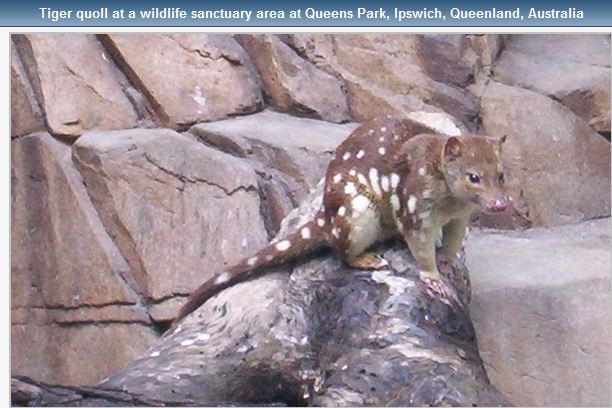 Spotted tail quoll have recently been found in Scenic Rim and evidence ie latine scats were found in Logan. These are two of wildlife threatened by changes to legislation by Newnan government which have potential to destroy most of our natural bushland areas in SEQ South east Queensland and without their habitat our wildlife will not survive. All bushland areas provide valuable food and shelter for species listed as threatened, those that are vulnerable and those regarded as 'common'. Unfortunately with reduction of 'green tape' even common species could disappear and these are also food sources for the predators higher up the food chain.
Our organization is regarded by some as extreme and anti-development, however we do support ecological sustainable development, and accounting for the value of natural capital. Many scientific studies and reports - peer reviewed and published - support our concerns. It is extraordinary that scientists with expertise in biodiversity conservation and sustainable development have publicly expressed grave concerns about the future impacts of proposed changes to Queensland's Vegetation Management Act and the Water Act. See their website http://concernedqldscientists.wordpress.com/.
Be informed and read government documents
Vegetation Mananagement Framework Bill - passed State Parliament Tuesday 21 May 2013. Natural Resources Minister Andrew Cripps said in a statement issued to Queensland Country Life that the passing of the Vegetation Management Framework Amendment Bill 2013 marked the beginning of a new era of sustainable agricultural production in Queensland
In addition World Wildlife Fund have produced WWF Report – Bushland at risk of renewed clearing in Queensland. Read it here.
Prominent among threatened species are the koala, Glossy black-cockatoo, Spotted-tailed and northern quolls. Many of us "do the right thing" but equally we are not necessarily well informed. What do farmers understand by sustainable agriculture?
The traditional big agribusiness is not sustainable when all costs are accounted. Dollars certainly count but who will pay long term when land becomes desert - as has happened.
 Eating - if we are fortunate - is a healthy enjoyable activity we each do three times a day. And in Austalia that is mostly true - but not for all. We believe too that as the world's population increases we need to grow more food. However while there are many people who do not have access - or have little access to enough safe healthy food some of us are hungry.
In addition to quantity there are other issues as the world's peoples grow fatter and eat inapproriate foods obesity and diabetes have become two of the biggest heath issues in Australia and globally.
Worryingly the food currently produced would feed the current global population and more but our distribution processes let us down.
What we eat and how and where our food is produced are complex issues that most of us are totally unaware of. Being a conscious consumer is an important part of living a responsible and sustainable lifestyle.
The theme for this year's World Environment Day celebrations is Think.Eat.Save. Think.Eat.Save is an anti-food waste and food loss campaign that encourages you to reduce your foodprint. According to the UN Food and Agriculture Organization (FAO), every year 1.3 billion tonnes of food is wasted. This is equivalent to the same amount produced in the whole of sub-Saharan Africa. At the same time, 1 in every 7 people in the world go to bed hungry and more than 20,000 children under the age of 5 die daily from hunger.
Given this enormous imbalance in lifestyles and the resultant devastating effects on the environment, this year's theme – Think.Eat.Save – encourages you to become more aware of the environmental impact of the food choices you make and empowers you to make informed decisions.
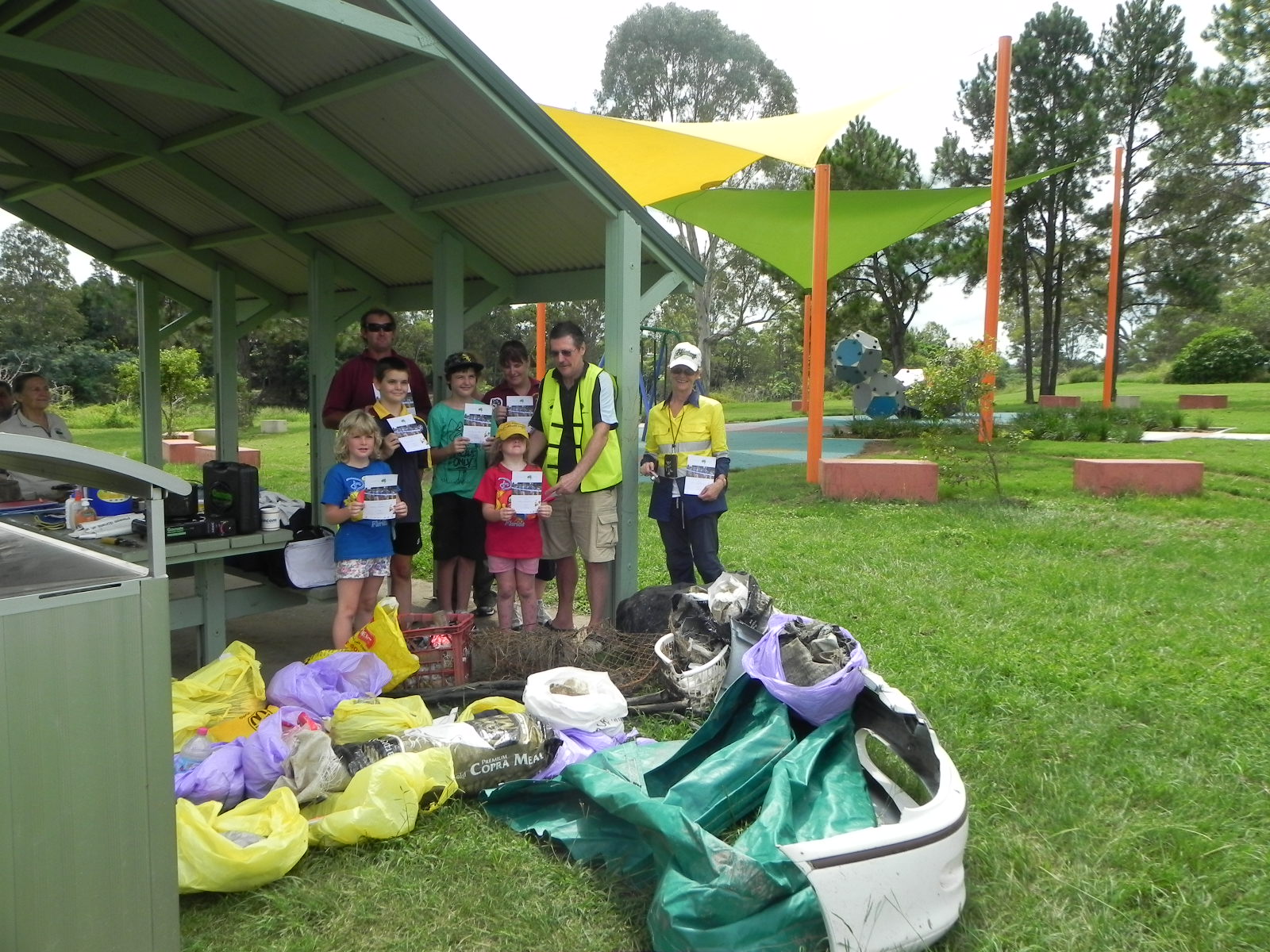 A great collaborative effort from the community has removed unsightly rubbish from a section of the Logan River. Logan Village Scouts got together with Logan and Albert Conservation Association (LACA), VETO Energex Towers Organisation (VETO) on Sunday 24 March 2013 to clean-up the Logan River and Larry Storey Park at Waterford. Our cleanup was supported by Healthy Waterways, Logan City Council and Clean-up Australia. The Clean-up Australia activity had to be postponed from earlier 3 March because the Logan River experienced a minor flood and safety for our rubbish collectors was a first priority.
Boat owners Greg Lord, Gary Hastings and Denis Higgins assisted us with the Clean-up on the river while the land team scouted the Larey Storey Park area for litter.
Regular river boaties and those who enjoyed their first time on the river are keener than ever to have wider community appreciation and enjoyment from Logan's greatest natural water asset.