
Logan and Albert Conservation Association
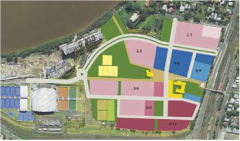 Yeerongpilly transit oriented development may provide some useful information for the Greater Flagstone area residents - may being the operative word. The Yeerongpilly TOD Concept Plan of Development supporting report outlines how the Yeerongpilly TOD may be developed over the next five to ten years and sets out strategies for various aspects such as transport, community development and environmental sustainability.
See the concept plan here. HAVE YOUR SAY.
The difference between Yeerongpilly and Greater Flagstone is that the former is to be built in an area which has already been developed - while Greater Flagstone is termed greenfield which means that there is currently no major development there. In order to 'manage growth' government prefers large landholders. Since these large landholders have been landbanking for future development - and financial gain.
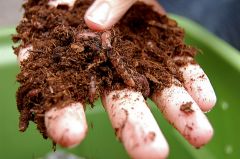 How our community gardening is growing in Logan and Scenic Rim
Gardening is an activity enjoyed by many residents in Logan City. There are many formal and informal groups that meet across all areas of Logan. Many grow flowers for their beauty, some grow food for the family table, many of us grow habitat plants for our local wildlife. What we all usually have in common is a willingness to share our surplus and share our knowledge of gardening.
Most of us are aware of the value of good soil and want to improve the productivity of our gardens - for food or flowers. Collectively we can achieve more at our local level. How much can we compost and create organic fertilizer or mulch from material others discard? Can we prevent it from going to landfill where it becomes a problem instead of the asset it can be.
I have always been an avid reader of gardening information - both the printed form and now online and for years have been reading great inspiring stories about people joining together to create community gardens in their local area.
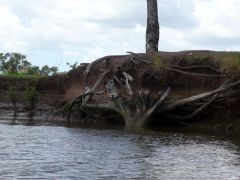
Following the release on Wednesday November 20 of the Healthy Waterways Ecosystem Health Report, in which the Albert and Logan Rivers each received fails for the second year in a row, general agreement has emerged within LACA and among other conservation groups across the region that the situation for this river/bay system is now critical and requires urgent new attention, NOT business as usual.
Continuation alone of the strategies put in place by SEQ Catchments and Healthy Waterways and responsible NRMs clearly will not provide the genuine on the ground, full system solutions that are now desperately needed. Their strategies, while clearly aimed at long term outcomes, have nevertheless been in place for ten years during which the rivers and bay areas in SE Qld have steadily declined, with the Logan/Albert/Southern Bay the worst performing system in
The need for a ‘Crisis
LACA members and others have expressed the view that urgent action is needed at a government/legislative level. To explore this and hopefully arrive at a collective decision, a ‘crisis summit’ on the rivers and bay has been proposed, to be held possibly in February 2011. As a ‘summit’ this will differ from the Logan City Council proposal for a ‘forum’. While a ‘forum’ usually involves open community access and input of ideas ending in a summary report, a ‘summit’ involves the key players and decision makers in a process of dialogue and collective decision making for action. However, the summit could take on board the information that might flow out of an earlier ‘forum’, so the two proposals are not necessarily mutually exclusive.
This issue encompasses the whole catchment area of the Logan and Albert Rivers, and as such includes the impacts on the system of major new development proposals including those at Flagstone, Yarrabilba, Bahrs Scrub and Bromelton. Accordingly, a ‘crisis summit’ would involve key decision makers from Federal, State and local government, landholders groups, Agforce, conservation groups, developers in the region, river based industry groups such as prawn farmers, tourism and amateur and professional fishing organisations. The starting point for the crisis summit should be the collective understanding that there is a ‘crisis’ in this system and that genuine new actions, possibly involving legislation, are needed in order to prevent the ecological and physical collapse of the river/bay system.
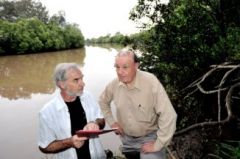 Logan / Albert / Southern Moreton Bay: Two fails in a row:
three strikes and you’re out?
The
The Logan / Albert Rivers and Southern Bay situation are worth so much to the State and the nation in a healthy condition that preventing an ecological shut down of the system must now be seen by the State Government as a ‘matter of State interest’.
Current international trends, highlighted by the recent Conference of the Parties to the Convention on Biological Diversity (COP-10) that concluded on October 29 in Nagoya, Japan, place increased imperatives on nations to adopt measures which incorporate the economic value of ecosystem services.
Queensland's ‘wild rivers’ legislation, which effectively frames the rivers as ‘biodiversity infrastructure’ whose systems, just like those of a road for example, must be made functional for the whole to begin to work is an exemplary model. It is possible that PES (payment for ecosystem services) could be applied to legislation to protect riparian areas, giving landholders cost neutral outcomes for productivity losses, fencing, revegetation etc.
We need to complement (or replace as necessary) the existing strategies with new whole-of-system initiatives over the next decade.
Read some coverage here in local news where several conservation group executive members express our concern.
"We are presiding over the final stages [of death] of a once healthy, productive and magnificent river system" said Barry Fitzpatrick. Unless we ensure that our river systems and bay are returned to a healthy functioning ecosystem, future health and wellbeing of the region is in jeapardy.
Biod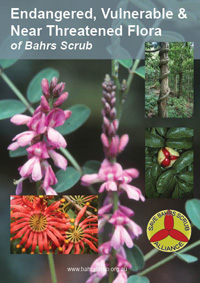 iversity is at the very heart of the survival of our human race and life on earth as we know it now. What we also know is that our present day activities and ways of living are having an enormous and detrimental impact on the planat and all of its species.
We all need each other to survive - yet we continue to whittle away at little bits - without being able to see the bigger picture.
Some plants within BAHRS SCRUB are unique - existing no where else in the world. Yet these plants are dependant on all surrounding pieces of biodiversity infrastructure. All eleven plants identified in the booklet are recognised as being endangered by Queensland or Australian governments. Will these plants survive in their natural environment? Or will we clear the busland for human settlement?
How much do you value the bushland and its creatures and what they contribute to our cultural life health and well being?
Are you someone who believes it is still necessary for economic prosperity that we continue to destroy our bushland. Only 200 years of western 'progress' may not always be viewed as progress?
LACA is one of the member groups of the SAVE BAHRS SCRUB ALLIANCE. We are all appreciative that our application for funding for this flora booklet was successful with Logan City Council's Envirogrant 2010 program.
Please obtain a copy of the booklet - read and enjoy the beauty of what is uniquely ours in Logan - and look out for the LOCAL AREA PLAN due to be released Monday 8 November 2010 for community consultation. Please involve yourself in this consultation process.
Click here or on the image to be download a cpoy of the booklet from the Save Bahrs Scub Alliance website.
More will be posted when the plan is available
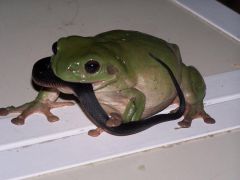 Fascinating and free reptile workshop
Capture your creatures on film after you find them - or they find you!
Brian 'Furry' McLean of Crocodiles and Dragons legend will demonstrate lots of useful information about our local reptile residents so that we can all live together harmoniously.
John McCann – professional wildlife photographer from Nature Pics will provide some secret so we can capture your creatures on film - the only way to catch them.
SATURDAY 6 NOVEMBER 2010
2 – 4.30 pm
CWA Hall Brisbane Street Beaudesert
LACA kindly thanks Scenic Rim Regional Council for funding the workshops through its Community Environmental Assistance Grants Program.
Our local zoologist - ecologist came to our assiatance at the last moment due to unforeseen circumstances. Thank you Ronda Green. Many cameras wer clicking madle as all attendees at our success workshop got very up close camera moments with Furry's creatures which are very used to the public - unlike our shy native animals in their natural habitat.
We hope to post some images soon so stay tuned. The shin of the crocodile is incredibly soft.
Local newspaper Jimboomba Times is now available online and have reported on this environmental isue here.
Senior member of the Healthy Waterways scientific expert panel Professor Rod Connolly presented the results to the southern region audience at the Gold Coast.
"With Logan we saw a slight improvement which came from a slight reduction in the levels of sediment and nutrients in the river," he said.
"The message for Logan is that what council and landowners are doing is excellent but we need to be working harder on two things.
"The first is the need for better processes in the development of greenfield sites, if we want healthy waterways we need to prevent sediment from escaping into our rivers.
"The second thing refers to rural areas where we are seeing a change from pastoral activity to all sorts of other land uses and again we need to ensure the sediment created by this change does not make it into the river.
"Planting bankside vegetation is one way of doing this but it is important for both council and landowners to take responsibility.
"Council's recent investment in sewerage treatment plant upgrades has been one of the most significant factors in improving the health of its waterways and hopefully it will result in further improvements."
Professor Connolly said he had considered the Albert Catchment to be in reasonably good condition but that the drop from an A- to a B- was a surprise.
"This is a meaningful decrease but at this point I couldn't jump in and say what the causes are," he said.
"We need to do more detective work to find out what has gone wrong before we can go down that route.
"Overall I would like to see more investment in waterways and we need to look at the new bulk water authorities to contribute a large fraction of the pie.
"More support for landowners and catchment groups would also be welcome."
Asked what impact new urban cities at Yarrabilba and Flagstone might have, Professor Connolly said as long as Water Sensitive Urban Design (WSUD) principals were followed, there was no need for a negative impact on waterways.
"The history of south-east-Queensland shows that when you have substantial number of people moving to new developments there is a decrease in the health of the streams and estuaries," he said.
"There are things that can be one to prevent this however and it just depends on how much the community wants to dedicate to the health of our waterways."
Senior member of the Healthy Waterways scientific expert panel Professor Rod Connolly presented the results to the southern region audience at the Gold Coast.
“With Logan we saw a slight improvement which came from a slight reduction in the levels of sediment and nutrients in the river,” he said.
“The message for Logan is that what council and landowners are doing is excellent but we need to be working harder on two things.
“The first is the need for better processes in the development of greenfield sites, if we want healthy waterways we need to prevent sediment from escaping into our rivers.
“The second thing refers to rural areas where we are seeing a change from pastoral activity to all sorts of other land uses and again we need to ensure the sediment created by this change does not make it into the river.
“Planting bankside vegetation is one way of doing this but it is important for both council and landowners to take responsibility.
“Council’s recent investment in sewerage treatment plant upgrades has been one of the most significant factors in improving the health of its waterways and hopefully it will result in further improvements.”
Professor Connolly said he had considered the Albert Catchment to be in reasonably good condition but that the drop from an A- to a B- was a surprise.
“This is a meaningful decrease but at this point I couldn’t jump in and say what the causes are,” he said.
“We need to do more detective work to find out what has gone wrong before we can go down that route.
“Overall I would like to see more investment in waterways and we need to look at the new bulk water authorities to contribute a large fraction of the pie.
“More support for landowners and catchment groups would also be welcome.”
Asked what impact new urban cities at Yarrabilba and Flagstone might have, Professor Connolly said as long as Water Sensitive Urban Design (WSUD) principals were followed, there was no need for a negative impact on waterways.
“The history of south-east-Queensland shows that when you have substantial number of people moving to new developments there is a decrease in the health of the streams and estuaries,” he said.
“There are things that can be one to prevent this however and it just depends on how much the community wants to dedicate to the health of our waterways.”
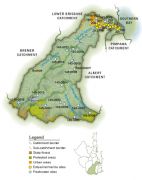 SEQ environment groups warn of the looming threat to Moreton Bay from the sheer scale of proposed urban development throughout the region. Over a decades worth of achievements could be undone if the massive new unsustainable urban development throughout SEQ is allowed to occur with out having to fully consider and put in place measures to avoid impacts to waterways.
Large-scale catchment wide rehabilitation projects and the adoption of world's best development standards in the vicinity of one billion dollars needs to be invested to repair catchment degradation throughout the region; otherwise the ecological health of Moreton Bay is likely to continue to decline overtime.
Another F for fail for the Logan River Estuary surely should mean that all levels of government should be aware of the damage our present human activites is causing and business as usual - despite the rhetoric - will not reverse the degradation.The southern Moreton Bay Ramsar site is also in poor health.
'The 2010 report card shows the condition of the Albert and Logan estuaries remain in poor condition, despite over ten years of hard work to improve their ecological health. The poor estuary health is caused by high nutrient and sediment levels, which is continued to be caused by existing inappropriate urban and industrial development throughout the catchment. Impacts to waterways are set to escalate if a business as usual approach is taken to the massive urban development planned for our part of the region.
When will the political will change to work towards a healthy catchment and ecosystem whose value for longterm human survival is essential. Without a healthy ecosystem [planet] we will not have a healthy sustainable lifestyle.
Queensland Conservation Association released their comment in this media release. QCC_healthywaterwaysreportcard20oct.doc Bytes 01/01/1970, 10:00
23 October 2010 - great day for conservation
Save Bahrs Scrub Alliance launch of booklet Endangered, Vulnerable and Near Threatened Flora of Bahrs Scrub
Saturday, October 23, 2010 Beenleigh Bowls Club Hanover St Beenleigh
11:00am – 12:00pm
 Download your invitation here.
  INVITATION_SBSA_FLORA_BOOKLET_LAUNCH.pdf
More information is available at http://www.bahrsscrub.org.au/
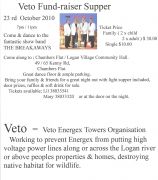
Veto fundraiser supper dance 7-11 pm
49-65 Kenny Rd Chambers Flat / Logan Village Community Hall
Tickets phone Lil 38035541 or Mary 38033320 or at the door ($10 single family $30)
See what is happening at www.veto.org.au
SURVEYS or CENSUS COUNTS for two local bird species - Sunday 31 October 2010
Glossy Black Cockatoo and Australian White Ibis.
If you want to take part in the Glossy Black-Cockatoo Birding Day check on the Conservancy website here.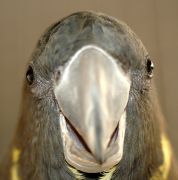 Source: Guy Castley
As the Glossy Black Cockatoo may be confused by another black bird, identification workshops are being held for those interested in helping. The Conservancy website has great identification tools as well. Please register at site linked above if you can help.
The Australian White Ibis is a protected native species that plays an important role in their natural wetland habitat. However, drought and inland water management issues have contributed to the White Ibis shifting to urban areas where they have found plentiful food, particularly at waste landfills. As a result, urban White Ibis populations have exploded over the last two decades. They are now often perceived as a 'pest' because of their nuisance value, risk to aviation safety, and impact on biodiversity.
Your participation in this survey will aid the long term conservation and effective management of Australian White Ibis by providing a better understanding of their distribution and abundance throughout Australia. Download a flyer here.